A fail-safe actuator moves a valve to a known, safe position, or holds it where it is, when the air, hydraulic pressure, power or signal that normally operates it is lost. That position is fail closed (FC), fail open (FO) or fail in place (FL). A fail-open valve is just as fail-safe as a fail-closed one if open is the safe state for that line.
The fail position is a process safety decision, set valve by valve in design and confirmed in hazard studies, not an actuator default. The actuator delivers it with stored energy, usually a spring or a hydraulic accumulator, or by holding position when the supply disappears.
Fail closed, fail open and fail in place explained
The fail state belongs to the whole valve package, because the actuator’s action and mounting decide which way the valve goes. With a spring-return pneumatic actuator, air-to-open means fail closed and air-to-close means fail open, so state the fail action in plain words on the data sheet.
Fail closed (FC). A fail-closed valve shuts when air, power or signal is lost. It is the usual choice where stopping flow removes the hazard, as on emergency shutdown and isolation valves for fuel gas, hydrocarbons and hazardous liquids. Industry guidance for LPG storage, referenced by the UK Health and Safety Executive (HSE), says remotely operated shut-off valves should close automatically on loss of actuating power.
Fail open (FO). A fail-open valve opens fully on loss of supply. It suits duties where losing flow is the bigger danger, such as cooling water to reactors and engines. Depressurisation (blowdown) valves are often designed to fail open too, so venting can continue if instrument air fails.
Fail in place, fail last or fail locked (FL). A fail-in-place valve stays where it was, which suits some modulating duties where a sudden move to either end of travel would upset the process. Double-acting actuators tend to do this, but process forces on an unbalanced valve can make it drift, so some duties add a lock-up valve to trap pressure in the actuator.
Fail-safe notation on P&IDs. Many P&IDs follow ISA-5.1, with the fail action written beside the valve as FC, FO or FL, or shown as an arrow on the actuator stem. Some drawings also use FI (fail indeterminate) or FIP (fails in place), and project legends may add their own variants, so always check the legend, including whether loss of signal and loss of motive power give different results.
How the fail action is decided
The process hazards should set the fail position, not habit or convention, and likely failures anywhere in the loop should drive the valve the same way. Fail actions are typically set during design and reviewed in a HAZOP (hazard and operability study), a systematic team review of the process for deviations from design intent, their causes and consequences.
IEC 61882 is the international application guide for HAZOP studies, and where a valve is the final element of a safety instrumented function, IEC 61511 also applies. Reviews should ask what happens if a valve never reaches its fail position, for example because of a broken linkage or sticking.
How fail-safe actuators work
Spring return (single-acting) actuators
In a spring return actuator, air or hydraulic pressure drives the valve one way and compresses a set of springs. Remove the pressure and the springs drive the valve to its fail position with no external supply, which is why spring return is common on emergency shutdown valves. Springs are simple and need no supply to act, but the energy they store is limited by their size, so they become less practical on very high-torque or high-thrust valves.
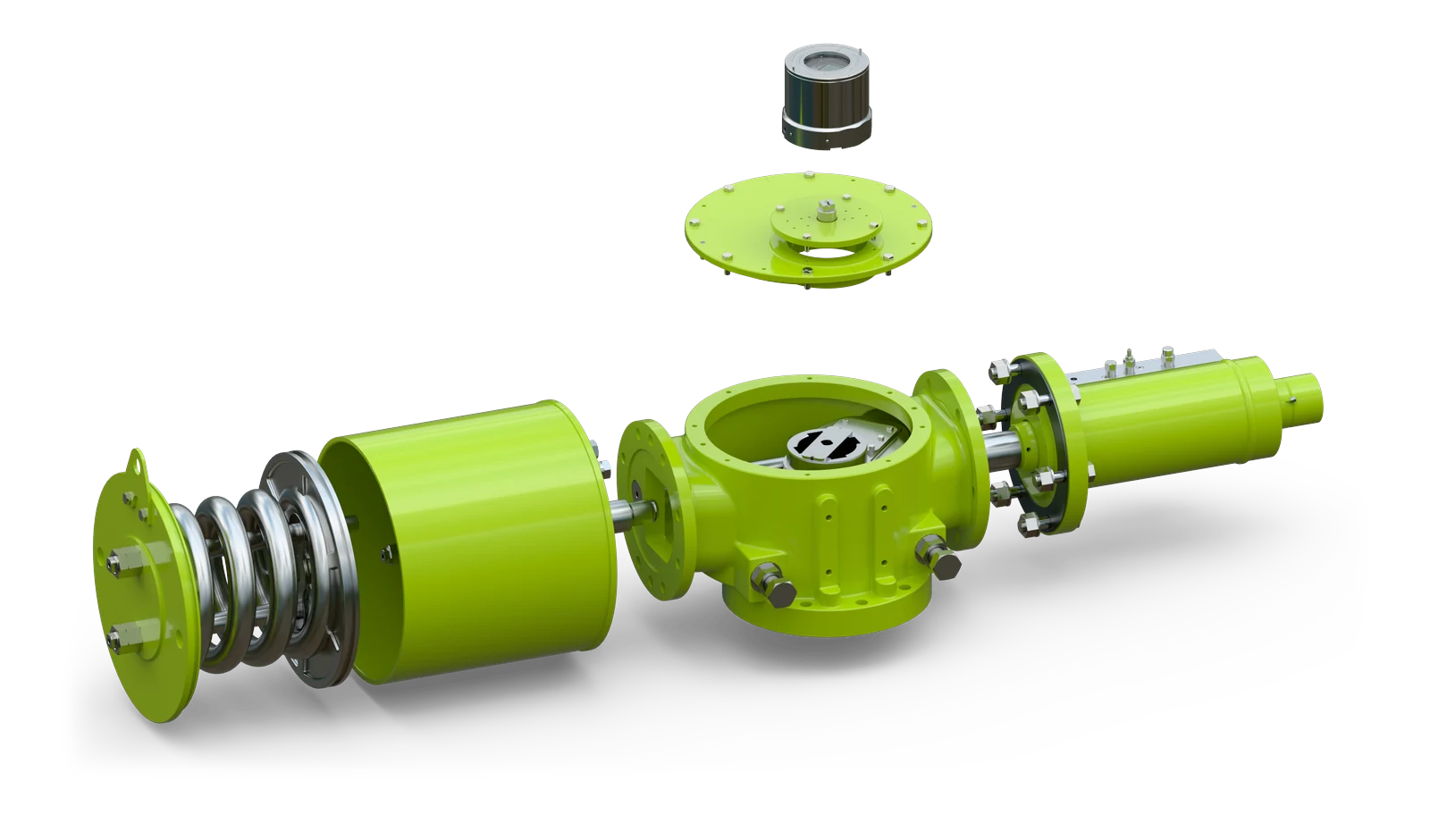
Stored hydraulic energy in accumulators
A hydraulic accumulator stores fluid against a gas precharge, usually nitrogen. On a trip or loss of supply, the hydraulic circuit releases the stored fluid and the compressed gas drives it into the actuator. Its useful volume depends on the precharge and working pressure range, and it must finish the fail stroke, or the number of operations needed, before pressure falls below what the actuator needs.
Double-acting actuators
A double-acting actuator is powered both ways and has no spring, so on loss of supply it generally stays put. A reserve air tank, or an accumulator on a hydraulic unit, can give it a fail-closed or fail-open action, though on large pneumatic actuators the tank gets bulky.
Actuators that hold position without power
Some designs lock mechanically between moves and hold position under load when power is cut. Electric actuators also typically stay put on power loss unless fitted with a spring, battery or supercapacitor backup.
What triggers the fail action
Common triggers are loss of supply (air or hydraulic pressure), loss of electrical power, loss of signal (a damaged cable, for example) and a deliberate emergency trip. They do not always give the same result. A double-acting actuator can be arranged to move on loss of signal using the air it still has, but once the air has gone it stays put unless it has stored energy, so specify the fail action for each case.
Solenoid valves: de-energise to trip. On many pneumatic fail-safe valves, a trip (dump) solenoid valve sits in the air line. Energised, it passes air to the actuator; de-energised, it vents the actuator and the spring drives the valve to its fail position. So a broken wire or power cut trips the valve to safety, just as a deliberate trip would. Some arrangements trap the air instead, locking the valve in place.
Quick exhaust valves. A quick exhaust valve vents the actuator to atmosphere at its port, rather than back through the solenoid and tubing, so the spring completes the fail stroke faster. Faster is not always better: HSE guidance on emergency isolation warns that closing too quickly can cause pressure surges, and long runs of larger pipework may need slower closure to prevent liquid hammer.
Trade-offs in fail-safe actuator sizing
Spring force at the end of the spring stroke
A spring’s force is proportional to its compression, so it pushes hardest at the start of the fail stroke and weakest at the end, just as a fail-closed valve needs torque to reseat. Starting from the valve maker’s torque data, check spring output across the whole stroke with a safety factor, at the maximum differential pressure.
A Scotch yoke helps because its lever arm is longest at the ends of travel, where breakaway and reseating happen, as our Scotch yoke vs rack and pinion guide explains. The powered stroke must overcome both valve and spring, so check it at the lowest expected supply pressure, not the normal one.
Testing and maintaining fail-safe valves
A fail-safe actuator only protects the plant if it reaches its fail position. Good practice typically includes:
- Full stroke (proof) testing: trip the valve and confirm it reaches its fail position in the expected time and, where facilities allow, shuts off tightly.
- Partial stroke testing: moving the valve typically 10 to 20% of its travel can reveal sticking without stopping the process. It does not test the seat, so it supplements full stroke tests rather than replacing them.
- Accumulator checks: confirm the gas precharge, remembering that energy stays stored in the gas after hydraulic pressure is released.
- Field inspection: look for damaged linkages, leaks, corrosion and sticking.
Test intervals depend on the duty. In a safety instrumented function, the proof test interval assumed in the design must be met in practice.
Fail-safe modes at a glance
| Fail mode | Typical notation | Typical mechanisms | Typical uses |
|---|---|---|---|
| Fail closed | FC | Spring return; hydraulic accumulator; double-acting actuator with stored air | Emergency shutdown and isolation valves, fuels, hazardous liquids |
| Fail open | FO | Spring return; hydraulic accumulator | Cooling water, blowdown valves |
| Fail in place | FL; sometimes FIP | Double-acting actuator; lock-up valve; mechanism that holds without power | Modulating duties where a sudden move would upset the process |
Where Advanced Actuators’ fail-safe ranges fit
Most fail-safe duties fall into a few well-understood arrangements, which our established, field-proven ranges already cover. Where a duty is genuinely different, we add bespoke engineering.
- HYLINE-R Scotch yoke actuators for ball, plug and butterfly valves: spring-return builds are fail-closed or fail-open, with springs in a sealed cartridge and 500 Nm to 6,192 Nm of spring torque at the fail position. Double-acting builds are fail-fixed. Solenoid and quick exhaust valves are supplied where required.
- HYLINE electro-hydraulic linear actuators for globe, sliding stem and control valves: spring-return or accumulator fail-safe, with accumulators up to 4 litres.
- HYFLOW smart hydraulic pumping units work with fail-safe actuators and can be configured with a fail-safe function; a remote valve fitted with one needs only a 24 V DC supply.
- HYSTEP stepping actuators hold position under high load even when external power is cut, and are widely used on choke valves.
- HYLINE-K rack and pinion actuators are double-acting and stay where they are if air is lost, so for fail-safe quarter-turn duty, choose HYLINE-R spring return.
For emergency shutdown in depth, see our guide to fail-safe hydraulic actuators for ESD valves.
Frequently asked questions
What is a fail-safe actuator?
A fail-safe actuator moves a valve to a set safe position, or holds it in place, when the air, hydraulic pressure, power or signal driving it is lost. Most use stored energy, typically a spring or hydraulic accumulator, so the fail stroke needs no external supply. Which position is safe is a process decision, confirmed in hazard studies.
What is the difference between fail open and fail close?
A fail-close valve shuts on loss of air, power or signal, which typically suits isolation and emergency shutdown of fuels and hazardous fluids. A fail-open valve opens fully and keeps flow going, which often suits cooling water and depressurisation duties. Neither is safer in general: the process decides.
How does a spring return actuator work?
Air or hydraulic pressure drives the valve one way and compresses springs inside the actuator. When the pressure is removed by a trip, power loss or supply failure, the springs push the valve back to its fail position. Spring force falls as the spring extends, so check that it still exceeds the valve’s torque, with a safety margin, at the end of the stroke.
What does fail last or fail in place mean?
Fail last, also called fail in place or fail locked and often marked FL on P&IDs, means the valve stays in its last position when supply or signal is lost. Double-acting actuators tend to do this, but process forces can make the valve drift, so lock-up valves can be added to trap pressure. It suits duties where a sudden full movement would cause more upset.
Is a double-acting actuator fail-safe?
Not on its own. With no spring, a double-acting actuator generally stays where it is on loss of supply, which suits fail-in-place duty. If the valve must close or open on loss of supply, choose a spring return actuator, or add stored energy such as a hydraulic accumulator or a reserve air tank sized for the fail stroke.
How often should fail-safe valves be tested?
There is no single interval: it depends on the duty and, for safety instrumented functions, on the proof test interval set in the design. Full stroke tests confirm the valve reaches its fail position in time. Partial stroke tests, often moving the valve 10 to 20% of its travel, check for sticking without stopping the process, but they cannot replace full tests because they do not test the seat.
Talk to our engineers about fail-safe actuation
Send us the valve type and size, the torque or thrust, the fail position from your hazard study, the supply available (air, hydraulic or 24 V DC) and the area classification. Email sales@advanced-actuators.com, call +44 (0)1535 655151 or use our contact page. Tell us the zone, gas group and temperature class, and we will confirm the certification for your exact unit. For quarter-turn fail-safe duty, start with HYLINE-R.