A Scotch yoke actuator turns the straight push of a piston into a quarter turn through a slotted yoke. Its lever arm is longest at each end of the stroke, so torque follows a U-shaped curve: highest at breakaway and reseating, lowest at mid-stroke. A rack and pinion actuator uses toothed racks on opposed pistons to turn a gear on the output shaft, so its torque stays broadly constant from 0° to 90°.
Rack and pinion units are compact, economical and the usual choice for small and medium ball, butterfly and plug valves. Scotch yokes put their torque where large valves need it most and usually take over as torque rises, including spring-return fail-safe duty on larger valves.
How a Scotch yoke actuator works
A piston drives a rod carrying a pin or slider block, which runs in a slot in a yoke on the output shaft and swings it through 90°. Air or hydraulic fluid drives the piston; on spring-return units, a spring module at the other end of the rod gives fail-safe return.
The Scotch yoke torque curve. At each end of the stroke the yoke sits at an angle to the rod, so the lever arm from shaft to pin is longest; at mid-stroke the yoke is square to the rod and the lever arm is shortest. A symmetrical yoke gives the same U-shaped curve in both directions, while a canted (angled) slot gives more torque at one end than the other.
How a rack and pinion actuator works
Two opposed pistons each carry a toothed rack meshing with a pinion gear on the output shaft. Air between the pistons drives them apart; on double-acting units, air to the outer chambers drives them back, while spring-return units have springs there. The pinion radius never changes, so torque stays broadly constant, and longer racks can give travel beyond 90°.
Why torque curves matter: breakaway, running and reseating torque
Quarter-turn valves rarely need the same torque throughout the stroke. Valve makers usually quote three figures, and their data should be your starting point:
- Breakaway torque (break-to-open): the effort to unseat a closed valve, often the highest figure.
- Running torque: the effort to keep it moving, usually much lower.
- Reseating torque (end-to-close): the effort to drive it back into the seat for tight shut-off, often similar to breakaway.
A Scotch yoke’s U-shaped curve mirrors this profile, so it can be sized for breakaway as long as its lower mid-stroke output still covers running torque. A rack and pinion sized for breakaway carries that surplus right through the stroke: little cost on a small valve, but a bigger, heavier and more expensive actuator on a large one.
Check torque at every position. Butterfly valves in high-flow service see flow-induced torque that can peak at around 75° to 80° open, and valves that rarely move may need extra breakaway margin. Compare torque position by position, and check that maximum supply pressure cannot push the actuator past the valve’s maximum allowable stem torque (MAST). Our guide to sizing a quarter-turn valve actuator sets out the method.
Typical torque ranges and valve sizes
Rack and pinion ranges typically run from a few newton metres to a few thousand; Scotch yoke ranges reach into the tens of thousands or more, especially hydraulic units. The two overlap, and the crossover varies with valve type, seat design, pressure class and media, so valve bore is only a loose guide. Where they overlap, torque profile, fail-safe needs, space and cost decide.
Spring-return and fail-safe options
A double-acting actuator drives the valve both ways and normally stays where it is if supply is lost. A spring-return (single-acting) actuator uses supply pressure one way and springs the other, driving the valve to its fail-closed or fail-open position. Our guide to fail-safe valve actuators compares springs with stored-energy alternatives.
How spring torque changes through the stroke
A spring weakens as it extends, so its force is lowest at the fail position, which on a fail-closed valve is exactly where reseating torque is needed. The air stroke loses torque too, as more of its force goes into compressing the springs. On a rack and pinion, spring torque falls steadily with spring force. On a Scotch yoke, the longer lever arm near the end of the stroke partly offsets the weaker spring. Either way, check spring torque against the valve’s needs through the whole spring stroke.
Size, weight and mounting
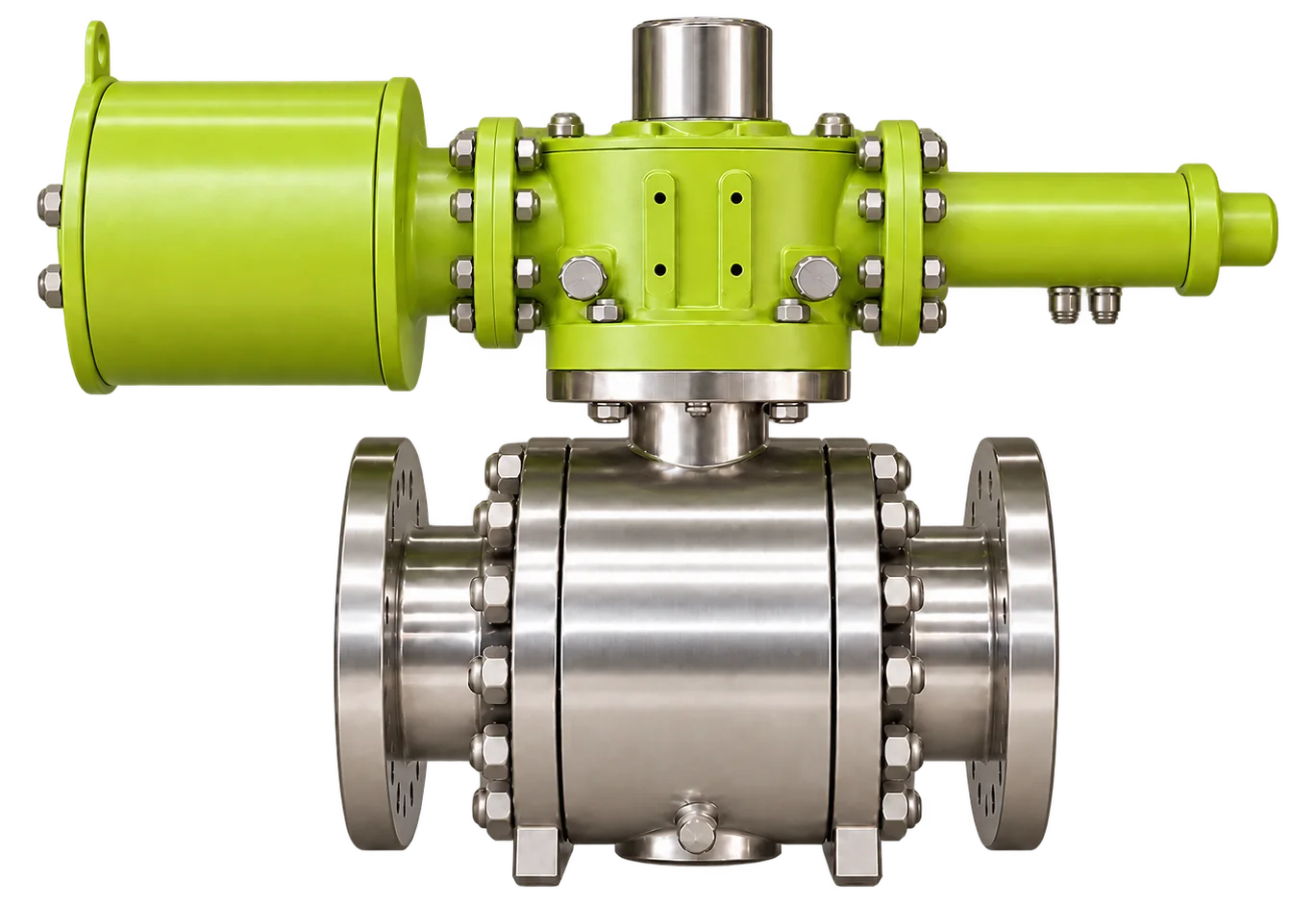
Footprint and weight. A rack and pinion is a compact, symmetrical block, light and easy to fit. A conventional Scotch yoke has its cylinder on one side of a central housing and, on spring-return units, the spring module on the other, so at modest torques it is bulkier. At high torques its leverage gives more torque for its size, especially in hydraulic versions.
ISO 5211 and NAMUR interfaces. ISO 5211 sets the flange and drive dimensions for attaching part-turn actuators to valves, and both types are commonly built to it, mounting directly or through a bracket and coupling. NAMUR interfaces (NE 19 and VDI/VDE 3845) let solenoid valves fit straight onto a pneumatic actuator’s air ports, with switchboxes and positioners on top.
Maintenance, service life and cost
Pneumatic versions of both designs need clean, dry air, commonly specified by ISO 8573-1 purity class. A rack and pinion’s typical wear points are its seals and gear teeth, and worn teeth add backlash, which causes deadband in modulating control. A Scotch yoke puts high side loads on its pin or slider block, yoke slot and rod guides, so good designs spread those contact loads. A rack and pinion is usually cheapest at small and medium torques, while a Scotch yoke usually becomes more economical as torque rises. Compare whole packages, including mounting kit, accessories and air consumption.
Scotch yoke vs rack and pinion: comparison table
| Aspect | Scotch yoke | Rack and pinion |
|---|---|---|
| Mechanism | Pin or slider in a slotted yoke | Racks on opposed pistons turn a pinion |
| Torque curve | U-shaped: highest at 0° and 90° | Broadly even |
| Typical torque | Higher torques, into tens of thousands of Nm | A few Nm to a few thousand Nm |
| Spring-return | Lever arm partly offsets the weaker spring at the fail position | Spring torque falls steadily to the fail position |
| Size and weight | Bulkier at modest torques; more torque for its size at high torques | Compact and light |
| Cost | Usually more economical at high torques | Usually cheapest at small and medium torques |
| Common duties | Isolation and shutdown | Modulating and general on-off |
Where each type is used in oil and gas, water and power
In oil and gas, Scotch yokes, often hydraulic, are common on pipeline isolation and emergency shutdown ball valves, with rack and pinion on smaller process and utility valves. In water and wastewater, rack and pinion is common on smaller treatment works valves, while large butterfly valves may need a Scotch yoke. Chemical, power, offshore and marine plants follow the same logic of size, torque and fail position.
Which should you choose? A quick checklist
Choose a rack and pinion actuator if:
- the valve needs up to a few thousand newton metres, fairly evenly through the stroke;
- space, weight or budget are tight;
- the duty is modulating, or you need travel beyond 90°.
Choose a Scotch yoke actuator if:
- breakaway and reseating torques dominate and run into thousands of newton metres;
- you need spring-return fail-safe action on a larger valve;
- a hydraulic supply is available, or the duty is isolation or shutdown.
Either way, check torque at your minimum supply pressure, MAST at your maximum, the fail position and the area classification.
Our quarter-turn ranges: HYLINE-K and HYLINE-R
Advanced Actuators’ established, field-proven ranges already cover the vast majority of quarter-turn duties, with bespoke engineering where a duty is genuinely different.
HYLINE-K rack and pinion actuators
HYLINE-K double-acting pneumatic rack and pinion actuators come in 15 sizes, AKD-032 to AKD-270, giving 9.2 Nm to 3,509 Nm at 6 bar, with ISO 5211 F03 to F16 flanges and NAMUR interfaces. HYLINE-K stays where it is if air is lost, so for fail-safe duty we point you to HYLINE-R spring-return.
HYLINE-R Scotch yoke actuators
HYLINE-R Scotch yoke actuators run on hydraulic or pneumatic supply, as double-acting (fail-fixed) or spring-return (fail-closed or fail-open) units. Across six sizes at 4 bar air, double-acting builds give 1,300 Nm to 16,350 Nm at the stroke ends and 700 Nm to 8,800 Nm at mid-stroke; spring-return builds give 500 Nm to 6,192 Nm of spring torque at the fail position. Hydraulic torque depends on supply pressure, and an optional integrated HYFLOW unit makes a self-contained package. For offshore and safety-critical duties, see our guide to high-torque rotary actuators.
The valve-type chooser on our actuator products page is a quick place to start. Where there is no air or hydraulic supply, our electric HYLINE-E range is an alternative. For hazardous areas, tell us the zone, gas group and temperature class, and we will confirm the certification for your exact unit.
Frequently asked questions
What is the difference between a Scotch yoke and a rack and pinion actuator?
A Scotch yoke turns piston thrust into a quarter turn through a slotted yoke, so torque is highest at the ends of the stroke and lowest mid-stroke. A rack and pinion turns a pinion gear using racks on opposed pistons, giving broadly constant torque. Rack and pinion suits smaller valves; Scotch yokes suit larger, higher-torque valves.
Rack and pinion vs Scotch yoke torque: which gives more?
A Scotch yoke concentrates torque at breakaway and reseating, while a rack and pinion gives roughly even torque throughout. On a Scotch yoke, mid-stroke torque is often only about half to two-thirds of the end figure. Scotch yoke ranges also reach far higher outputs, into tens of thousands of newton metres; rack and pinion ranges typically stop at a few thousand. Compare torque at every valve position.
Why are Scotch yoke actuators used on large valves?
Large ball, plug and butterfly valves often need most torque to break away and reseat, and much less in between. A Scotch yoke matches that profile, so it can be sized for the peaks without carrying surplus torque through mid-stroke. It also scales economically to high outputs and suits hydraulic supplies and spring-return fail-safe duty.
Can a rack and pinion actuator be fail-safe?
Yes. Rack and pinion actuators are widely made in spring-return as well as double-acting versions. A double-acting unit stays where it is on loss of air unless stored air and extra controls are added. Our HYLINE-K range is double-acting, so for fail-safe duty on loss of air we point customers to HYLINE-R spring-return.
Which is better for modulating control, Scotch yoke or rack and pinion?
A rack and pinion with a positioner is a common choice for modulating small and medium quarter-turn valves, as even torque suits frequent small movements. Keep backlash low, since it creates deadband. Scotch yokes are more often used for on-off, isolation and shutdown duty, but can modulate where mid-stroke torque comfortably covers the valve.
Do Scotch yoke and rack and pinion actuators fit the same valve mounting?
Usually, at the interface. Both are commonly built to ISO 5211, which standardises flange and drive dimensions for part-turn actuators, and pneumatic versions normally carry NAMUR interfaces for solenoid valves, switchboxes and positioners. Flange size, drive shape and any bracket or coupling must still match the valve, so check the mounting kit when switching types.
Talk to our engineers
Send the valve type, size, breakaway, running and reseating torques, supply and pressure, fail position and area classification to sales@advanced-actuators.com or call +44 (0)1535 655151. You can also use our head office contact page, or see the HYLINE-R product page for fail-safe quarter-turn duty.