An explosion-proof valve actuator is an actuator package designed so that it will not ignite the flammable gas, vapour or dust around the valve. The protection might be a flameproof (Ex d) enclosure that contains an internal explosion, intrinsic safety (Ex i) that keeps electrical energy too low to ignite anything, or another concept from the IEC 60079 series.
The hydraulic or pneumatic actuator itself is mechanical and is assessed as non-electrical equipment, while the positioners, switches and solenoid valves on it need an electrical protection concept. For a chemical plant or refinery, start from the zone, gas group and temperature class.
What makes a valve actuator explosion-proof?
Explosion-proof, flameproof and intrinsically safe. Under IEC standards, an enclosure that contains an internal explosion is flameproof (Ex d); “explosion-proof” is the North American term. Intrinsically safe (Ex i) instead prevents ignition by limiting energy. A valve body has no electrical parts, so an “intrinsically safe valve” means one whose actuator and instruments are protected.
Mechanical actuators and electrical accessories. ISO 80079-36 covers non-electrical equipment, naming hydraulic and pneumatic motors among its examples, and requires a documented ignition hazard assessment of risks such as hot surfaces, mechanical sparks and static electricity. ISO 80079-37 adds the protection types “c”, “b” and “k”, and compliant equipment is marked Ex h. Solenoid valves, positioners, switches and pump motors fall under the IEC 60079 series.
Hazardous area zones for gas and dust
The site operator classifies areas, typically using IEC 60079-10-1 (gas) and IEC 60079-10-2 (dust). In Great Britain, DSEAR requires employers to classify zones, select equipment to suit and, where necessary, mark entry points with the “EX” sign.
- Zone 0 (gas) and Zone 20 (dust): explosive atmosphere present continuously, for long periods or frequently.
- Zone 1 and Zone 21: likely to occur occasionally in normal operation.
- Zone 2 and Zone 22: not likely in normal operation, and brief if it does occur.
Equipment protection levels and ATEX categories. For gas, equipment protection level (EPL) Ga is “very high”, Gb “high” and Gc “enhanced”, traditionally matched to Zones 0, 1 and 2; dust uses Da, Db and Dc. Under DSEAR, Zones 0 and 20 need ATEX category 1 equipment, Zones 1 and 21 category 1 or 2, and Zones 2 and 22 any of categories 1 to 3.
Gas groups and temperature classes
Gas groups IIA, IIB and IIC. Group II gases are subdivided by how easily they ignite and how readily a flame passes through a narrow gap. Representative gases are propane (IIA), ethylene (IIB), and hydrogen and acetylene (IIC). IIC equipment also suits IIB and IIA areas. Dusts form Group III: IIIA combustible flyings, IIIB non-conductive and IIIC conductive dust.
Temperature classes T1 to T6. The temperature class caps the maximum surface temperature, which must stay below the auto-ignition temperature of every substance present: T1 450 °C, T2 300 °C, T3 200 °C, T4 135 °C, T5 100 °C, T6 85 °C. It is separate from gas group: hydrogen and acetylene are both IIC, yet auto-ignite at about 560 °C and 305 °C. Temperature classes assume an ambient of -20 °C to +40 °C unless the marking states otherwise.
Explosion protection concepts for actuator packages
Where each protection concept fits on a valve package:
| Concept | How it prevents ignition | Zones | Where it fits |
|---|---|---|---|
| Flameproof, Ex d (IEC 60079-1) | Enclosure contains an internal explosion | 1 and 2 | Positioners, transmitters, solenoid valves, motors |
| Increased safety, Ex e (IEC 60079-7) | Extra measures against arcs, sparks and heat | 1 and 2 | Terminal boxes, some motors |
| Intrinsic safety, Ex i (IEC 60079-11) | Energy limited below ignition level, even with faults | 0, 1 and 2 (level ia) | Low-power sensors, switches, signal loops |
| Pressurisation, Ex p (IEC 60079-2) | Protective gas held above outside pressure, with monitoring | 1 and 2 | Cabinets and panels with a gas supply |
| Dust protection, Ex t (IEC 60079-31) | Dust-excluding enclosure, limited surface temperature | 20, 21 and 22 | Electrical items in dusty areas |
| Non-electrical, Ex h (ISO 80079-36 and -37) | Ignition hazard assessment and constructional measures | As assessed | The hydraulic or pneumatic actuator |
Flameproof Ex d for powered devices. A flameproof enclosure does not keep gas out; it withstands any internal explosion, and close-fitting flamepaths stop the flame escaping. Level db gives EPL Gb, for Zones 1 and 2. With no limit on power, Ex d suits solenoid valves, positioners and motors, but unlike intrinsically safe circuits it is typically opened only with the power isolated or under a gas-free permit.
Intrinsic safety Ex i: signals, not motors. Intrinsic safety keeps the energy in a circuit and its wiring below what could ignite the atmosphere by sparks or heating. A barrier or isolator in the safe area limits voltage and current, so available power is typically around 1 W or less: enough for a transmitter or proximity sensor, too little for motors, pumps and higher-power solenoid valves. Level ia tolerates two faults and is permitted in Zone 0, ib one fault, and ic suits Zone 2 only.
ATEX, UKEX, DSEAR and IECEx explained
ATEX covers two EU directives: 2014/34/EU for equipment and protective systems, electrical or mechanical, and 1999/92/EC for protecting workers, including zoning. In Great Britain, the Equipment and Protective Systems Intended for Use in Potentially Explosive Atmospheres Regulations 2016, which industry often shortens to UKEX, use the UKCA mark, while DSEAR 2002 covers the workplace. CE-marked equipment also remains acceptable in Great Britain: legislation in force since 1 October 2024 removed the end date for recognising CE marking, and as of October 2026 GOV.UK guidance gives none.
IECEx is the IEC’s international certification scheme. A Certificate of Conformity follows type testing and a factory assessment, and equipment not listed on the IECEx online system is not IECEx certified. North American codes, such as the US National Electrical Code, also use classes and divisions, for example Class I, Division 1.
What to ask for when buying an explosion-proof actuator
A complete enquiry should state:
- Zone or EPL, for gas, dust or both.
- Gas group or dust group.
- Temperature class or maximum surface temperature.
- Ambient range, especially outside -20 °C to +40 °C.
- Ingress protection for weather, washdown or immersion.
- Materials for housings, fasteners, tubing and seals.
- Cable entries, such as M20 or 1/2 in NPT, with glands and stopping plugs that suit the protection concept.
- Documentation: certificates, markings, specific conditions of use (an “X” after the certificate number) and instructions.
Installation and inspection: IEC 60079-14 and IEC 60079-17
IEC 60079-14 covers design, selection and installation of electrical equipment, including initial inspection and staff competence. IEC 60079-17 covers inspection and maintenance in service, and IEC 60079-19 repair and overhaul. Our after sales and repair service covers overhaul, repair and spares.
Explosion-proof actuators for chemical plants and refineries
Explosion-proof linear actuators suit globe and control valves, and rotary (quarter-turn) actuators suit ball, plug and butterfly valves on chemical transfer lines, refinery units and tank farms. Chemical plants and refineries add:
- Hydrogen: areas where hydrogen or acetylene may be present need IIC equipment, or equipment rated for hydrogen.
- Corrosion: acid vapours, chlorides and process chemicals attack housings, fasteners and cable glands.
- Washdown: choose an IP rating that copes with hosing down as well as weather.
- 316L stainless steel: molybdenum gives 316 much better chloride pitting resistance than 304, but chloride stress corrosion cracking becomes a risk from around 50 °C in chloride-bearing water.
- Fail-safe duty: ESD valves need a defined fail action; see fail-safe hydraulic actuators for ESD valves.
Where there is no air or hydraulic supply, an electric actuator with a suitably protected motor is an alternative.
Our actuators and Ex d instrumentation for hazardous areas
Our established, field-proven ranges already cover the vast majority of real-world applications, with bespoke engineering where a duty is genuinely different.
- HYLINE electro-hydraulic linear actuators for sliding stem, globe and control valves on modulating, ESD and isolating duties: four standard sizes up to 100,000 kgf thrust, with a 316 stainless steel cylinder option and 316L manifold, tubing and fittings.
- HYLINE-R Scotch yoke actuators for ball, plug and butterfly valves: hydraulic or pneumatic, double-acting or spring-return, IP67, with chemical processing among its sectors.
- HYLINE-K pneumatic rack and pinion actuators, with 304 or 316 stainless steel bodies as options, and HYSTEP stepping actuators for choke valves at wellheads and on FPSO vessels.
HYCONTROL is an intelligent positioner and HPU controller in a 316L stainless steel flameproof (Ex d) housing, IP66, with an optional stainless steel Ex terminal box. It is set up from magnetic buttons without opening the enclosure, and its solenoid outputs switch 24 V DC at 1 A, well beyond what an intrinsically safe circuit can deliver. See our guide to intelligent valve positioners.
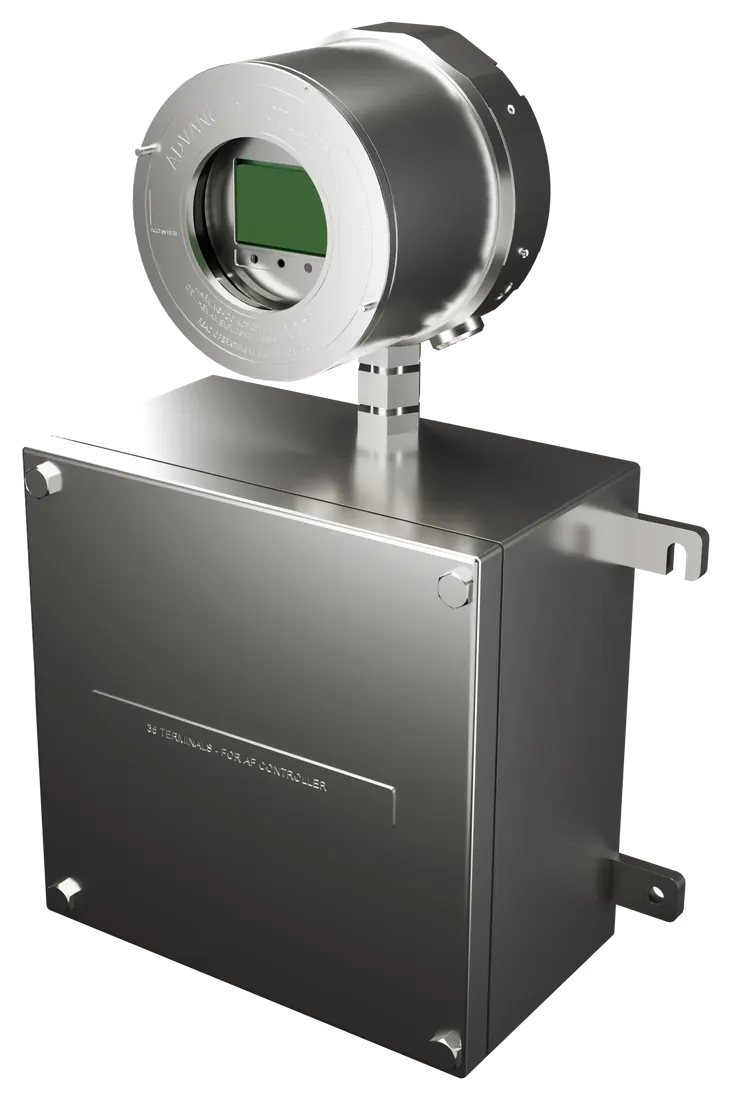
HYTRACK is a 4-20 mA, HART 7 position transmitter in a 316L housing, and the wider instrumentation family adds HYSOL Ex d solenoid valves, HYSWITCH switches and sensors, and HYDRIVE motors. Each instrument’s hazardous-area certificates are listed on its product page. Tell us the zone, gas group and temperature class, and we will confirm the certification for your exact unit.
Frequently asked questions
What is an explosion proof valve actuator?
An explosion-proof valve actuator is an actuator package designed so that it will not ignite the flammable gas, vapour or dust around it. A hydraulic or pneumatic actuator is assessed as non-electrical equipment, while its positioner, switches and solenoid valves use concepts such as flameproof Ex d or intrinsic safety Ex i. The package must match the site’s zone, gas group and temperature class.
What is the difference between ATEX and IECEx?
ATEX is European law: directive 2014/34/EU sets the requirements that equipment for explosive atmospheres must meet before sale in the EU, shown by the CE mark. IECEx is an international certification scheme run under the IEC, with certificates listed online. Both build on the IEC 60079 and ISO 80079 standards. Great Britain has its own 2016 regulations, often called UKEX, and as of October 2026 also recognises CE marking.
Can a valve actuator be intrinsically safe?
Rarely as a whole. Intrinsic safety limits a circuit to very low power, typically around 1 W or less, which suits sensors, switches and transmitters but not motors, pumps or higher-power solenoid valves. In practice, intrinsically safe actuators are hydraulic or pneumatic actuators with intrinsically safe signal devices, and flameproof Ex d for parts needing more power.
Does a pneumatic or hydraulic actuator need ATEX certification?
Under ATEX, non-electrical equipment is in scope where it has its own potential ignition source, such as a hot surface or mechanical sparks. The manufacturer’s documented ignition hazard assessment, to ISO 80079-36, establishes this, and compliant equipment is marked Ex h. The solenoid valves, switches and positioners fitted to the actuator are electrical equipment and need their own protection.
What does an ATEX actuator marking such as II 2 G Ex db IIC T4 Gb mean?
Read it left to right. II is equipment group II (places other than mines), 2 is ATEX category 2 and G means gas. Ex db is a flameproof enclosure at protection level db, IIC is the gas group, T4 limits the maximum surface temperature to 135 °C, and Gb is the equipment protection level, which suits Zones 1 and 2.
Which materials suit explosion-proof actuators in chemical plants?
316L stainless steel is a strong candidate for housings, tubing and fittings. Its molybdenum gives better resistance to pitting by chlorides than 304, and the low-carbon grade improves weldability. It is not immune, so check compatibility with the actual chemicals, temperatures and washdown regime, and review seals, coatings and cable glands in the same way.
Talk to our engineers about explosion-proof actuation
Send us the valve type, size, torque or thrust, the supply available (air, hydraulic or 24 V DC) and the area classification, including the zone, gas group and temperature class, and we will confirm the certification for your exact unit. Email sales@advanced-actuators.com, call +44 (0)1535 655151 or use our contact page, and see our Ex d instrumentation.