Valve actuators for water treatment and water utilities open, close and position the valves and gates that move water from source to tap and back again. They drive penstocks and sluice gates at reservoirs and works inlets, butterfly and gate valves at pumping stations and on distribution mains, knife gates on sludge lines and control valves on treatment processes.
The right actuator matches the valve’s torque or thrust, the duty (on-off isolation or modulating control), what must happen if power fails and the supply available on site. Many water assets are wet, below ground or remote, so corrosion protection, ingress protection and reliable feedback to SCADA matter as much as raw output.
Where valve actuators are used across the water cycle
Automated valves appear at almost every stage, from abstraction to final effluent.
| Location | Typical valves and gates | Typical duty |
|---|---|---|
| Abstraction, reservoirs and dams | Penstocks, sluice gates, draw-off and scour valves | Isolation, controlled release, emergency closure |
| Water treatment works | Butterfly valves, filter valves, control and dosing valves | Sequenced on-off, level and flow control |
| Pumping stations | Pump suction, delivery and bypass valves | Isolation, controlled opening and closing |
| Distribution networks | Butterfly and gate valves on mains and at service reservoirs | Isolation, flow and pressure management |
| Wastewater and sludge | Penstocks, knife gates, sludge and aeration air valves | Isolation, sludge transfer, air control |
| Tunnels and transmission | Large isolation and roller gates, transfer main valves | Isolation, storm and flood control |
Water treatment works and pumping stations. At treatment works, filter valves cycle through backwash sequences and must report position reliably, while filter outlet and flow control valves often modulate. At pumping stations, isolation valves typically sit either side of each pump, and delivery valves often close at a controlled speed to limit surge.
Distribution networks and municipal water supply. In municipal water supply, automated valves typically sit at service reservoirs, booster stations, transfer mains and pressure zone boundaries. Many are large butterfly valves in below-ground chambers, rarely visited yet expected to work first time, so remote position indication is vital.
Wastewater, sludge, tunnels and transmission. Wastewater brings solids, grit and corrosive gases. Knife gate valves are common on sludge lines because the blade cuts through solids. Aeration is often the largest energy user at an activated sludge plant, so air control valves need smooth, repeatable modulation. Deep storm and transfer tunnels put actuators in shafts that can flood.
What matters when specifying valve actuators for water treatment
Corrosion resistance and coatings. Treatment works combine humidity, condensation and chemicals such as chlorine. In sewers and wet wells, bacteria convert hydrogen sulphide into sulphuric acid, which attacks concrete and metals. Classify each location to ISO 12944-2, such as C4 or C5 for aggressive atmospheres or Im1 and Im2 for immersion in fresh or sea water, and choose a coating system rated for it. State chemical or sewer gas exposure separately, and consider stainless steel where splash or chemicals are present.
Ingress protection and submergence in chambers. Under IEC 60529, the second digit of an IP code covers water. A 6 means protection against powerful jets, a 7 temporary immersion between 0.15 m and 1 m, and an 8 continuous immersion under conditions agreed between manufacturer and user. An immersion rating does not include jet protection unless both are stated, for example IP66/IP68. For chambers and shafts that can flood, state the depth and how long the actuator must survive and still operate, not simply IP68.
Modulating control valves or on-off isolation. Isolation valves need to open and close reliably, with limit switch or 4-20 mA confirmation. Control valves, such as filter outlet and aeration air valves, hold intermediate positions and move often, so they need fine resolution, low hysteresis and a positioner to close the loop.
Fail-safe action on loss of power or air. Decide whether each valve must fail closed, fail open or stay put if power, air or signal is lost. Spring-return actuators and hydraulic accumulators store the energy to reach the safe position, as our guide to fail-safe hydraulic actuators explains. Speed matters too: closing a valve on a long main too quickly can cause water hammer, so base closing times on a surge analysis.
Power and air availability at remote sites. Larger treatment works have mains power and often compressed air. Reservoir outlets, trunk main chambers and remote outstations may have only a limited 24 V DC supply, so the power an actuator draws while holding position matters as much as its output.
SCADA feedback, manual override and maintenance access. Operators need valve position in the control room, typically 4-20 mA, often with HART, plus open and closed limit switches. Many specifications also call for a manual override, such as a handwheel or hand pump. HSE advises avoiding confined space work wherever possible, so place controls, indicators and overrides where they can be reached from outside.
Sewer gas and hazardous areas. Where sewer gas or biogas can build up, for example in enclosed wet wells, shafts or digestion plant, parts of a site may be classified as hazardous zones under DSEAR in Great Britain or the ATEX directives in the EU, and equipment there must suit the zone. Tell us the zone, gas group and temperature class, and we will confirm the certification for your exact unit.
Pneumatic, hydraulic or electric actuators for water treatment
All three are used in water; site supply, valve size and fail-safe needs usually decide.
- Pneumatic actuators suit works with a dependable compressed air supply. They are simple and quick, and spring-return versions fail safe easily, but need clean, dry air.
- Hydraulic actuators deliver high force from a compact body, suiting large gates, long strokes and high-torque valves in tight spaces. Power comes from a ring main or a self-contained pumping unit at each valve.
- Electric actuators are widely used where mains power is available and there is no air or hydraulic supply. Our HYLINE-E electric quarter-turn actuators are one option.
Where an actuator or its hydraulic fluid could contact drinking water, check what the water company accepts. In England and Wales such products may need approval under Regulation 31 (Regulation 33 in Scotland); elsewhere, check local requirements.
How Advanced Actuators ranges fit water and wastewater duties
Our established, field-proven ranges already cover the vast majority of real-world valve applications, with bespoke engineering where a duty is genuinely different. Typical water applications include penstocks, gate valves, knife gates, roller gates, tunnels and transmission.
HYLINE for linear valves
HYLINE electro-hydraulic linear actuators combine electric control with hydraulic force for isolating, modulating and emergency shutdown duties on globe, sliding stem and control valves. Four sizes cover 100 kgf to 100,000 kgf of thrust and strokes up to 300 mm, with spring-return or accumulator fail-safe and IP65, IP66 or IP68 builds. It runs from a hydraulic ring main, or self-contained with an integrated HYFLOW 24 V DC pumping unit. For penstocks and large gates, ask about a bespoke hydraulic cylinder, as on the Tideways project below.
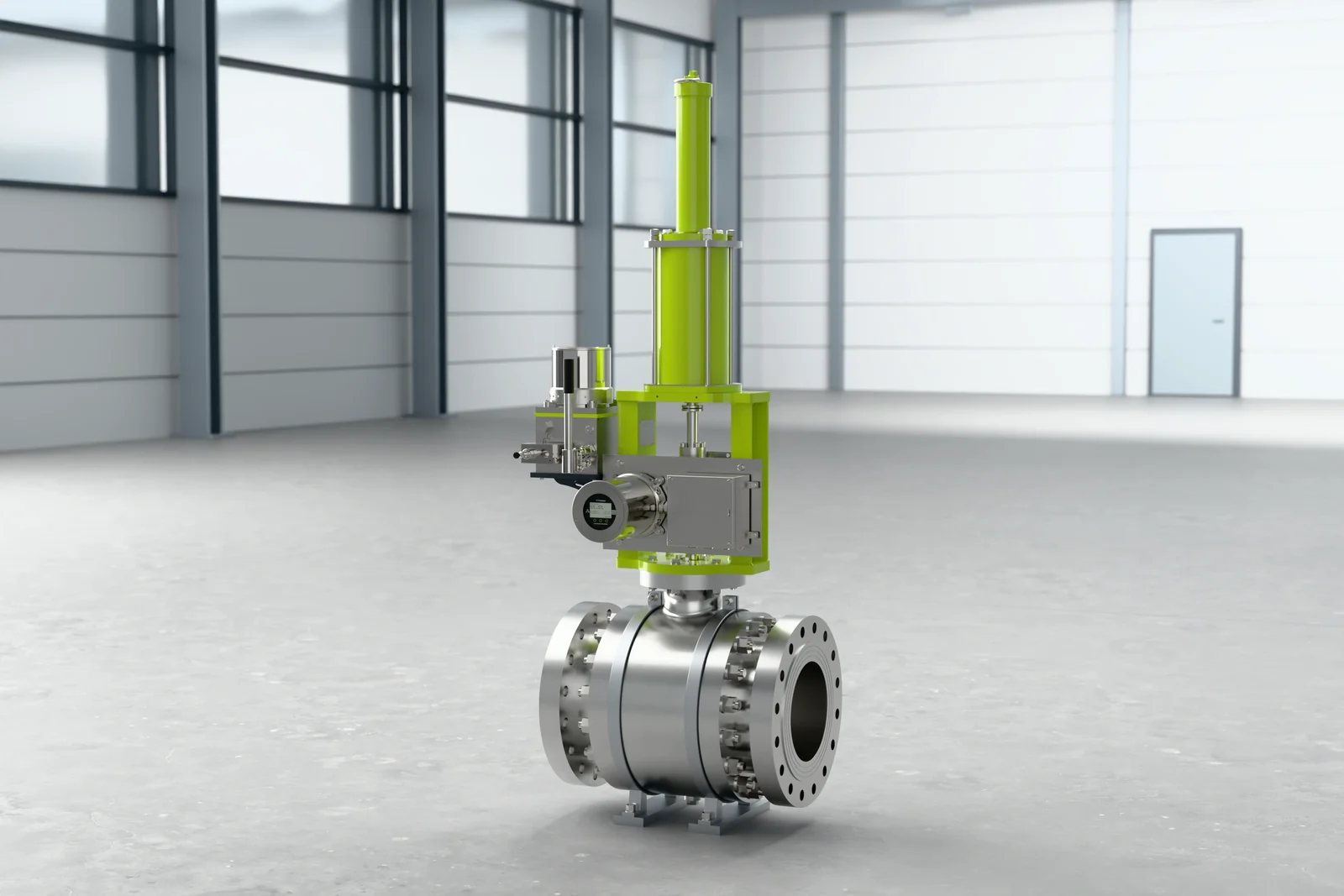
HYLINE-R for large quarter-turn valves
HYLINE-R Scotch yoke actuators suit ball, plug and butterfly valves in water and wastewater, including large, high-torque valves. Torque peaks at breakaway and reseating, where valves need it most, and dips at mid-stroke. Pneumatic double-acting models give 1,300 Nm to 16,350 Nm at the stroke ends on 4 bar air; spring-return versions fail closed or fail open; hydraulic versions give high torque from a compact envelope. Units are IP67 with an ISO 5211 valve interface.
HYLINE-K where compressed air is available
HYLINE-K rack and pinion actuators suit a wide range of quarter-turn valves where a dependable air supply is available. Fifteen sizes give 9.2 Nm to 3,509 Nm at 6 bar, with stainless steel bodies and C5M coating available. HYLINE-K stays where it is if air is lost, so for fail-safe duty choose HYLINE-R spring-return.
HYFLOW for remote sites with only 24 V DC
HYFLOW smart hydraulic pumping units mount with the actuator and need only a 24 V DC supply. HYFLOW draws below 1 W in steady state while holding position, has a 316L stainless steel housing rated IP66 and NEMA 4X, and can be configured with a fail-safe function.
HYTRACK position feedback to SCADA
HYTRACK position transmitters send valve position to SCADA as a two-wire, loop-powered 4-20 mA signal with HART 7, from a 316L stainless steel housing rated IP66 and NEMA 4X. Mechanical or proximity limit switches are optional.
Proven in a flooding tunnel shaft
On the Thames Water Tideways project, we designed, built, installed and commissioned a hydraulic cylinder and its controls for the main isolation roller gate, 80 m down a shaft that can flood. It must work submerged up to 80 m deep for up to 14 days, and in an explosive atmosphere when the shaft is drained. Available submersible feedback devices were rated only to 4 m for 2.5 hours, so we built hyperbarically tested protective cases for the limit switches and 4-20 mA feedback device, and integrated the system with the client’s SCADA. It has been in service for over six years, with regular flooding of the shaft.
Frequently asked questions
What type of actuator is used on penstocks and sluice gates?
Penstocks and sluice gates move a gate across an opening, so they need a linear actuator with enough thrust to overcome gate weight, seal friction and water load over the full travel. Hydraulic cylinders suit large gates because they deliver high force from a compact body, and electric actuators driving a threaded stem are also common. Start from the gate maker’s thrust figures.
Are hydraulic actuators suitable for water treatment facilities?
Yes. Hydraulic actuators suit water treatment facilities where valves or gates are large, space is tight, or a valve must fail safe using energy stored in springs or accumulators. They can run from a central ring main or a self-contained pumping unit at each valve. Where hydraulic fluid could reach treated water, agree the fluid and its containment with the water company.
What valve actuators are used in municipal water supply?
Municipal water supply networks use quarter-turn actuators on butterfly and ball valves, and linear or multi-turn actuators on gate valves and penstocks. Electric actuators are common where mains power is available; pneumatic and hydraulic actuators are chosen where air or hydraulic power exists or stored-energy fail-safe action is needed. Many valves sit in unmanned chambers, so dependable SCADA feedback is essential.
How do I choose a corrosion-resistant valve actuator for water treatment?
Start with the environment: humidity, chlorine vapour, hydrogen sulphide in wastewater areas and any risk of immersion. Choose a coating system for the ISO 12944 corrosivity category, stainless steel where splash or chemicals are present, and seals suited to the temperature range. Ask for each unit’s coating specification and materials list in writing, so you can check them against your site standard.
Can a valve actuator work submerged in a flooded valve chamber?
It can, if it is built and tested for the specific depth and duration. IP68 covers continuous immersion under conditions agreed between manufacturer and user, so it has no fixed depth: state how deep the chamber can flood and how long the actuator must survive and still operate. In deep shafts, limit switches and transmitters may need extra protective housings tested to the required pressure.
Do I need a modulating or an on-off rotary actuator for water treatment?
Use an on-off rotary actuator for isolation, filter sequencing and pump valves, where the valve is fully open or fully closed. Use a modulating rotary actuator where the valve sets a flow, level, pressure or air rate, such as filter outlets, aeration air and dosing lines. Modulating duties typically need a positioner and a 4-20 mA command; on-off duties mainly need dependable limit switches.
Talk to our engineers about water treatment valve actuators
Send us the valve or gate type, size, torque or thrust, stroke, available supply (air, hydraulic or 24 V DC), fail-safe requirement, and any area classification or submergence conditions. Email sales@advanced-actuators.com, call +44 (0)1535 655151 or contact our head office, and our engineers will recommend a suitable actuator. For large quarter-turn valves, start with the HYLINE-R range.