A valve actuator for a power plant has to move large valves and dampers reliably, often close to hot steam lines, and leave them in a safe position if power or supply is lost. The most demanding duties are usually on the steam and water side: turbine bypass, attemperator spray water, feedwater and steam isolation, plus the large dampers on the combustion air and flue gas path.
The right actuator depends on the valve’s motion, the thrust or torque it needs, whether it modulates or simply opens and closes, and what it must do on loss of supply. Hydraulic actuators are often chosen where a duty needs high force and stiff, precise control. Pneumatic actuators are common on quarter-turn isolation where plant air is available, and electric actuators are an option where neither supply is practical.
Where actuated valves and dampers sit in a power plant
Thermal and combined-cycle power plants
- Turbine bypass: in a combined-cycle plant, the bypass routes steam to the condenser during start-up, low load, shutdown and turbine trips, so the gas turbine and heat recovery steam generator (HRSG) can keep running. It must act immediately on a trip.
- Spray water and attemperation: attemperators inject water to control steam temperature, typically between superheater or reheater stages and in bypass lines. The spray water valve needs very high turndown and tight shutoff.
- Feedwater and steam isolation: control valves regulate water into the boiler or steam generator, and isolation valves on feedwater and steam lines must close reliably on demand.
- Draught dampers: forced and induced draught systems set combustion air flow and furnace pressure by fan speed, dampers or both. Large dampers can need high torque and precise positioning.
- Start-up and anti-surge: vents, drains and bypasses operate as the unit warms through, and anti-surge valves on compressors, such as fuel gas compressors at some gas turbine plants, must open fast enough to prevent surge.
- Cooling water: large quarter-turn valves isolate pumps, condensers and cooling circuits on once-through and recirculating systems.
Biomass power plants and fuel handling
A rotary valve (rotary airlock) meters fuel with a vaned rotor while holding an air seal, and can act as a barrier against burn-back. Fuel, air and ash lines may also use actuated isolation valves, slide gates and dampers. Wood dust can explode, so connected equipment may need explosion isolation (covered in Europe by EN 15089), and areas where explosive atmospheres may occur must be classified into zones (DSEAR in the UK, or equivalent rules elsewhere). Tell us the zone, gas group and temperature class, and we will confirm the certification for your exact unit.
Hydroelectric power plants
The turbine inlet valve, often a spherical or butterfly valve, is a safety device that closes against flow in an emergency such as turbine runaway or a pipe rupture. It is commonly operated by a hydraulic servomotor, and its closing time is set with care, because closing too fast raises penstock pressure (water hammer).
Nuclear power plants
Nuclear stations share many steam and water duties with other thermal plants, under far tighter control. Equipment important to safety must be qualified to perform under the conditions it could face, including accident conditions such as high temperature, pressure, humidity and radiation, to requirements set by the national regulator and the plant’s qualification programme.
Typical power plant valve duties at a glance
| Duty | Typical motion | What the actuator must do |
|---|---|---|
| Turbine bypass | Linear (control valve) | Modulate, respond immediately on a trip, reach a defined position on loss of supply |
| Spray water | Linear (control valve) | Fine modulation over a wide range, tight shutoff |
| Feedwater control and isolation | Linear or quarter-turn | Steady control; close on demand |
| Air and flue gas dampers | Quarter-turn, or linear via a lever | High torque, stable positioning, defined fail action |
| Cooling water, fuel and auxiliary isolation | Quarter-turn | Reliable open and close, with a defined fail action where needed |
| Hydro turbine inlet valve | Quarter-turn | High torque, controlled emergency closing |
What matters when choosing a power plant valve actuator
High force and torque, sized from the valve data. Start with the valve maker’s breakaway, running and reseating figures, then add a suitable safety margin. Some duties are very large: the steam damper in our power station damper case study needed 1.3 million Nm, beyond off-the-shelf actuators, so we designed a custom modulating hydraulic actuator and verified it with stress analysis.
Temperature near steam lines. Actuators often sit near hot pipework or boiler casings, where local temperatures can run well above the general plant figure, and electronics may reach their limit before seals do. Check the temperature at the mounting point. HYLINE is specified for -30 °C to +80 °C ambient; if your location runs hotter, talk to us early.
Duty cycle and modulating control. Spray water and damper duties often modulate continuously, and cycling plants add many more movements: one trade review puts a typical attemperator system at 700 to 1,000 thermal cycles a year, about double on cycling units. Look for fine resolution, a firm hold on position and a closed-loop positioner such as the HYCONTROL valve positioner.
Fail-safe action on loss of supply. Decide what each valve must do if power, air or hydraulic pressure is lost: fail closed, fail open or stay put. Spring-return and accumulator designs move the valve to its safe position; the Mexico damper, for example, had to fail closed on loss of electrical power. Our guide to fail-safe valve actuators explains the options.
Manual override for power plant actuators. A manual override lets operators move a valve during commissioning, a power loss or maintenance, commonly by handwheel, gearbox or, on hydraulic actuators, a hand pump. Check how it interacts with any spring or accumulator, and tell us your plant standard so we can confirm the options.
Position feedback to the DCS. A 4-20 mA position signal is widely used, and HART adds digital diagnostics over the same wiring. HYLINE offers HYTRACK feedback (4-20 mA with HART 7), and HYTRACK has mechanical or proximity limit switch options to confirm end positions.
Corrosion-resistant actuators for cooling water and coastal sites. Cooling water systems and coastal sites are hard on actuators, so check body material, coating and ingress protection. HYLINE-K offers 304 or 316 stainless steel bodies and a C5M offshore coating; HYLINE-R is O-ring sealed to IP67.
Maintenance during planned outages. Much overhaul work is planned into outages, when valves can be stroked, stripped and tested offline. Agree spares and scope early, because the work plan often changes once a shutdown begins. We have overhauled the hydraulic systems that operate critical valves at UK nuclear power stations during outages, and our after-sales team covers overhaul, repair and spares.
Linear vs quarter-turn, hydraulic vs pneumatic vs electric
Linear or quarter-turn actuators. Linear actuators push and pull a valve stem, suiting globe, gate and sliding-stem valves such as many bypass and spray water control valves. Quarter-turn (rotary) actuators turn ball, butterfly and plug valves through 90°, a common choice for cooling water isolation and dampers.
Hydraulic actuators for power generation. Hydraulic fluid is effectively incompressible, so hydraulic actuators give high force from a compact cylinder and hold position firmly. They need a hydraulic supply, from a central power unit or a pumping unit at each valve, and accumulators can store energy for fail-safe action.
Pneumatic rotary actuators. Where plant air is available, pneumatic rotary actuators are simple and cost-effective, and spring-return versions fail safe on loss of air. Rack and pinion designs give broadly even torque; Scotch yoke designs give more torque at the stroke ends, suiting larger valves.
Electric actuators. Electric actuators suit sites with no air or hydraulic supply; without a spring or backup supply they generally stay put on power loss. See our HYLINE-E electric quarter-turn actuators.
How Advanced Actuators ranges fit power plant duties
Our established, field-proven ranges already cover the vast majority of real-world valve applications, with bespoke engineering where a duty is genuinely different.
HYLINE for linear control and isolating valves
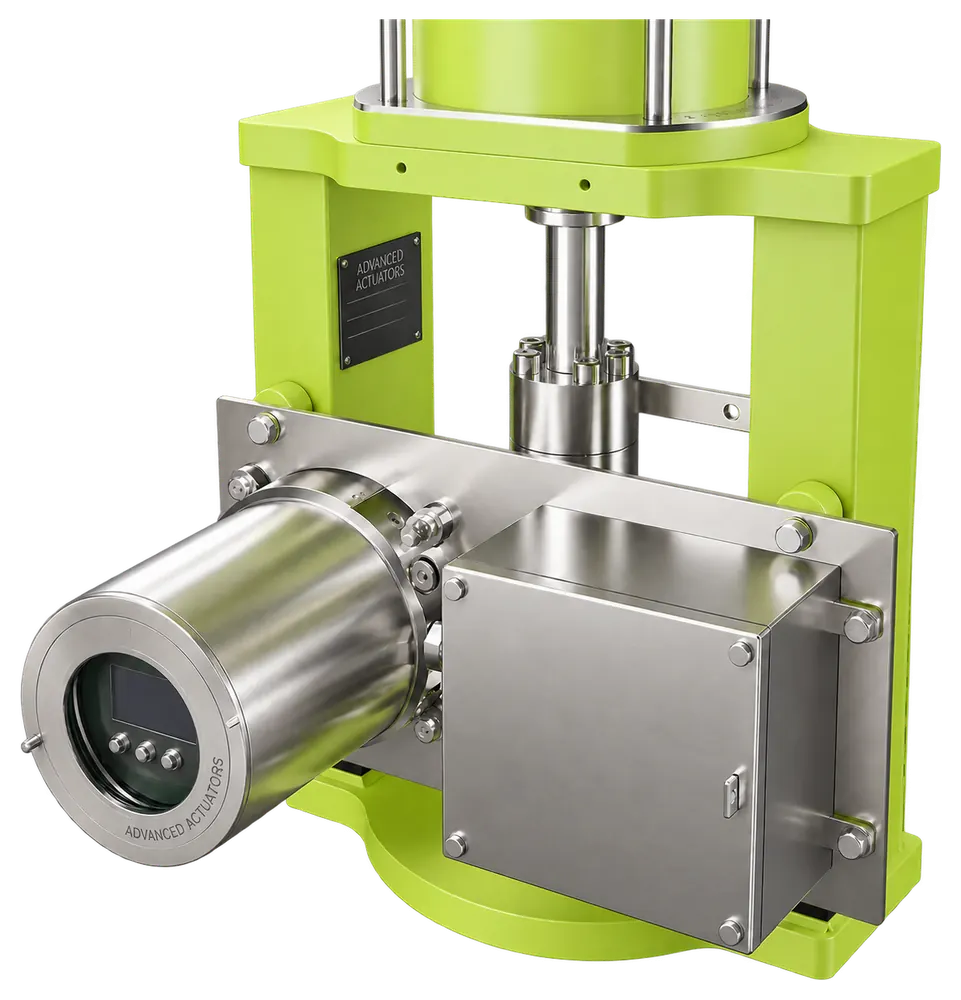
HYLINE electro-hydraulic linear actuators combine electric control with hydraulic force and list power generation among their sectors. Four standard sizes cover 100 kgf to 100,000 kgf of thrust with strokes up to 300 mm, for modulating, isolating and ESD duties on globe, sliding-stem and control valves. Fail-safe action is by spring-return or accumulator, with HYTRACK feedback and HYCONTROL closed-loop control available. HYLINE runs from a hydraulic ring main or self-contained with an integrated HYFLOW 24 V DC pumping unit, giving each valve its own local power source.
HYLINE-R for quarter-turn isolation
HYLINE-R Scotch yoke actuators drive ball, plug and butterfly valves and list power generation among their sectors, suiting duties such as cooling water and auxiliary isolation. Torque peaks at 0° and 90°, where valves break away and reseat. Units are hydraulic or pneumatic, double-acting (staying put on loss of supply) or spring-return (fail-closed or fail-open); pneumatic double-acting torque at 4 bar is 1,300 Nm to 16,350 Nm at the stroke ends.
HYLINE-K for auxiliary and utility valves
HYLINE-K rack and pinion actuators suit a wide range of quarter-turn valves, such as smaller auxiliary and utility valves, with 9.2 Nm to 3,509 Nm at 6 bar across 15 sizes, tested to 1 million cycles. They are double-acting and stay put if air is lost, so choose HYLINE-R spring-return where a valve must fail safe.
Frequently asked questions
Which valve actuator is right for a power plant?
It depends on the duty. For linear control valves on turbine bypass, spray water and feedwater duties, electro-hydraulic linear actuators offer high force and precise modulation. For quarter-turn isolation on cooling water and auxiliary systems, pneumatic or hydraulic rotary actuators are common, with spring-return where the valve must fail safe. Always size from the valve maker’s thrust or torque data.
Are rotary actuators used in power plants?
Yes. Rotary (quarter-turn) actuators drive butterfly, ball and plug valves on cooling water, fuel and auxiliary systems, and many dampers on the air and flue gas path. Scotch yoke designs give high torque at the stroke ends for large valves; rack and pinion designs give broadly even torque for smaller ones.
When is a hydraulic actuator the right choice for power generation?
Choose hydraulic where the valve or damper needs high force or torque, stiff and precise modulation, or stored-energy fail-safe action from an accumulator. A power generation hydraulic actuator can run from a central ring main or from a self-contained pumping unit at each valve, which avoids long pipework runs.
Does a power plant actuator need a manual override?
Many plants specify one so operators can move a valve during commissioning, a power loss or maintenance. A handwheel, gearbox or hydraulic hand pump are common forms. Check how the override works with any spring or accumulator and how it is disengaged. Tell us your plant standard and we will confirm the options for your actuator.
Which valves are actuated in a biomass power plant?
Alongside the usual steam, feedwater and cooling water valves, biomass plants automate fuel handling. Rotary valves (rotary airlocks) meter fuel while holding an air seal, and fuel, air and ash lines may use actuated isolation valves, slide gates and dampers. Wood dust can also bring explosion risks, so confirm the area classification early.
How are power plant valve actuators maintained?
Much of the inspection and overhaul is planned into outages, when valves can be stroked, stripped and tested with the unit offline. On hydraulic actuators, typical work covers seals, cylinders, accumulators and pumps, plus positioner and feedback calibration. Agreeing spares and scope beforehand helps keep the work on programme.
Talk to our engineers about power plant valve actuators
Send us the valve or damper type and size, the torque or thrust required, the supply available (hydraulic, air or electric), the fail-safe action and the area classification, and we will recommend the right actuator. Email sales@advanced-actuators.com, call +44 (0)1535 655151 or use our contact page. For linear control valves, you can also start with the HYLINE range.