An intelligent valve positioner makes a modulating valve go where the control system asks. It takes the command signal, typically 4-20 mA, measures where the valve actually is, and drives the actuator until the two agree, overcoming the friction, stick-slip and process forces that would otherwise leave the valve off target.
Intelligent, smart and digital all describe a microprocessor-based positioner: it calibrates in a few steps, is configured in software, and reports position, status and faults, commonly over HART. Positioners are commonly associated with pneumatic actuators, but a modulating hydraulic actuator needs one too. Our HYCONTROL works with both and can also run the hydraulic pump.
What does a valve positioner do?
A control system asks for a valve position with a signal, typically 4-20 mA, scaled across the valve’s travel. A positioner is a small closed-loop controller on the actuator. It measures the actual stem or shaft position, compares it with the command and adjusts the actuator drive until the error is gone.
Why use a positioner: friction, stick-slip and deadband
Packing and trim friction hold a valve still until enough force builds to break it free. Static friction is higher than moving friction, so the stem jumps and sticks again. This stick-slip, or stiction, turns a smooth command into stair-stepped movement. On reversal, friction must be overcome in the new direction, so small command changes produce no movement: this is deadband.
Add differential pressure on the plug, and an actuator without a positioner can sit well off target. A positioner keeps driving until the position matches, for accuracy and repeatability. A pneumatic positioner also passes a high air flow for a faster response, and a double-acting actuator, with no spring to balance it, needs one to hold mid-travel.
Analogue versus digital valve positioners
Conventional positioners are mechanical or analogue: a cam, beam or linkage feeds stem movement back to a pneumatic relay or simple electronics. An intelligent or digital valve positioner uses a microprocessor and an electronic position sensor instead. IEC 61514-2, the international standard for evaluating intelligent valve positioners with pneumatic outputs, covers static and dynamic performance, degree of intelligence and communication.
| Feature | Conventional (analogue) | Intelligent (smart, digital) |
|---|---|---|
| Position sensing | Mechanical linkage, cam and spring | Electronic sensor, such as a magnetic non-contact type |
| Set-up | Mechanical zero and span adjustment | Guided calibration from buttons or software |
| Control behaviour | Set by the mechanical parts fitted | Configurable, such as deadband, characterisation and travel limits |
| Communication | The control signal only | Commonly HART on the 4-20 mA loop |
| Diagnostics | None built in | Status, alarms, travel data and valve health tests |
HART positioners and smart diagnostics
A HART positioner is an intelligent positioner that communicates using HART. HART superimposes a small digital signal on the 4-20 mA loop without disturbing the analogue value, so the same two wires carry the command and two-way data: device status, diagnostics, extra measured values and configuration such as characterisation and travel limits. Diagnostics that smart valve positioners commonly offer include:
- position error and total travel, to help plan maintenance
- supply and output pressures, on pneumatic units
- valve signature tests that reveal friction, trim interference or seat wear
Positioners for pneumatic and hydraulic actuators
Pneumatic positioners modulate air. On a pneumatic actuator, the positioner feeds air from the instrument supply into or out of the actuator until the position matches: against the spring on a spring-return actuator, or on both sides of the piston on a double-acting one.
Hydraulic positioners drive valves, motors or pumps. A hydraulic positioner controls whatever directs oil to the actuator: on-off solenoid valves, proportional or servo valves that vary the flow continuously, a reversing motor, or the pump on a self-contained unit. HYCONTROL drives solenoid valves or a DC reversing motor, checks the valve position until it matches the command, and can also run the HPU pump.
Intelligent electric actuators. A throttling electric actuator needs its own valve position sensor, and modulating electric actuators often build that control in, so a separate positioner is not always specified. Where there is no air or hydraulic supply, our HYLINE-E range offers modulating (4-20 mA) or intelligent control.
Dead zone, pulsing and stepping modes
With solenoid valves or a reversing motor the drive is on or off, so three settings shape how the positioner approaches its target.
- Dead zone: a band around the set point where the valve counts as in position. Wider means less hunting and solenoid or motor wear; narrower means tighter positioning. HYCONTROL: 0 to 5%.
- Pulsing zone: a band outside the dead zone where the drive is typically pulsed rather than held on, so the actuator approaches the set point gradually. HYCONTROL: 0 to 10%.
- Stepping mode: short moves with adjustable on and off times for fine, stepped positioning. HYCONTROL has this mode and can drive HYSTEP, which turns electrical pulses into discrete steps and holds position under high load even when external power is cut.
HYSTEP is widely used upstream, especially on choke valves: see precise choke valve control with stepping actuators.
Action on loss of signal
Decide what the valve should do if the positioner loses its command or feedback signal. Loss of power or supply is a separate case, handled by the actuator’s own spring or accumulator where fitted. HYCONTROL can be set to fail open, fail close or stay put, with selectable behaviour on a command or feedback signal break. For spring-return and accumulator options, see our guide to fail-safe valve actuators.
Integral or separate position feedback
HYCONTROL has two versions:
- A-HC: the positioner, working from its integral rotary sensor or from a 4-20 mA position input.
- A-HCR: the positioner with a HYTRACK position transmitter built in, so one unit gives control and feedback.
HYCONTROL reports back with a 4-20 mA retransmit and fault relays. HYTRACK is a two-wire, loop-powered 4-20 mA transmitter with HART 7 and a 12-bit contactless sensor.
Positioners in hazardous areas
Hazardous areas are zoned by how likely an explosive gas atmosphere is: Zone 0 (present continuously or for long periods), Zone 1 (likely in normal operation) and Zone 2 (not likely, and brief if it occurs). Equipment is selected for the zone, gas group and temperature class.
A flameproof (Ex d) enclosure, one of the protection concepts recognised for Zone 1 equipment, is built to withstand an internal explosion and stop it passing to the explosive atmosphere around the enclosure. HYCONTROL calibrates in two steps from magnetic buttons without opening its enclosure. HYCONTROL’s own certificates are listed on its product page, as are those of each Ex d instrument in our instrumentation range. Tell us the zone, gas group and temperature class, and we will confirm the certification for your exact unit.
How to choose an intelligent valve positioner: a checklist
- Actuator: pneumatic or hydraulic, linear or quarter-turn, double-acting or spring return.
- Drive: air, solenoid or proportional valves, a motor or a pump.
- Signals: command, HART, retransmit, relays and monitoring inputs.
- Fail action: on signal loss, and on loss of power or supply.
- Feedback: integral sensor or separate transmitter, plus limit switches.
- Area classification: zone, gas group, temperature class and ambient range.
- Mounting: rotary or linear, ingress protection, materials and cable entries.
HYCONTROL intelligent valve control in detail
HYCONTROL is our intelligent position controller for modulating valves, including choke valves, on hydraulic or pneumatic actuators. It combines closed-loop control, accurate positioning, actuator diagnostics and HPU control in one flameproof unit.
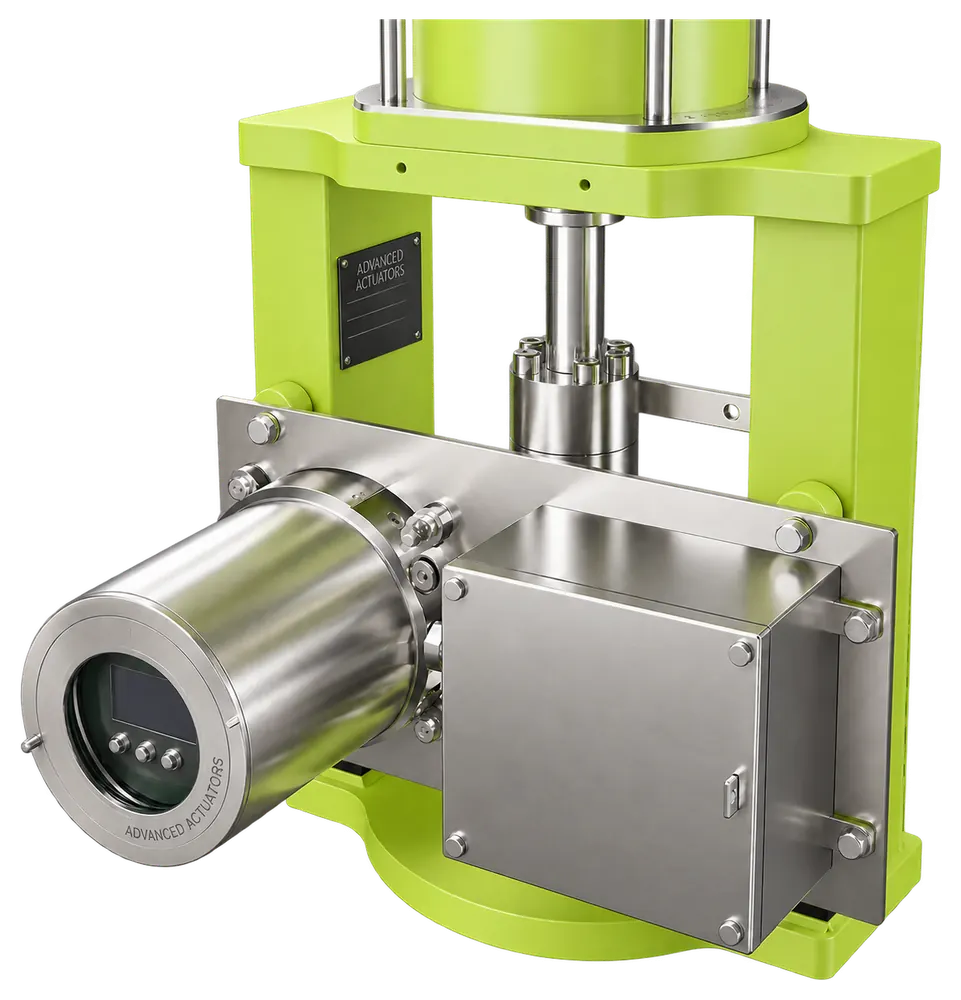
HYCONTROL key specifications
- Actuators: double-acting, spring to close or spring to open; hydraulic or pneumatic.
- Signals: isolated 4-20 mA command (5 V voltage drop); isolated 4-20 mA or integral sensor feedback; HART 7.
- Inputs and outputs: three isolated 24 V DC digital inputs for oil and fault monitoring; two changeover relays (24 V, 1 A); solenoid outputs 24 V DC, 1 A, low-side switching.
- Power: 24 V DC, 0.1 A (17 to 30 V DC).
- Construction: 316L stainless steel flameproof housing; optional 316 stainless steel Ex terminal box; IP66 and NEMA 4X; ambient -40 °C to +50 °C; 3 x M20 or 3 x 1/2 in NPT entries; about 10 kg.
- Options: two or four mechanical or proximity switches; mechanical indicator for rotary actuators.
HPU control and actuator diagnostics
On a hydraulic package, HYCONTROL can run the pump on pressure or on demand, with a 0 to 5 V DC pump speed signal. It monitors and logs faults such as oil level, oil temperature, accumulator pressure, and motor and pump faults.
Pairing HYCONTROL with HYLINE, HYLINE-R, HYSTEP and HYFLOW
- HYLINE electro-hydraulic linear actuators, for sliding stem, globe and control valves, offer HYCONTROL as their closed-loop controller option.
- HYFLOW smart hydraulic pumping units offer HYCONTROL positioning. Together, HYLINE, HYFLOW and HYCONTROL make a self-contained, intelligent, integrated control valve actuator that needs only a 24 V DC supply and a 4-20 mA command.
- HYLINE-R Scotch yoke actuators, hydraulic or pneumatic, for ball, plug and butterfly valves.
- HYSTEP stepping actuators, through the stepping mode.
Our actuator and instrumentation ranges
Our established, field-proven ranges already cover the vast majority of real-world applications, with HYCONTROL and HYTRACK adding closed-loop control and feedback, and HYSOL solenoid valves and HYDRIVE motors as building blocks. Where a duty is genuinely different, we engineer a bespoke package.
Frequently asked questions
What is an intelligent valve positioner?
An intelligent valve positioner is a microprocessor-based device on a valve actuator. It compares the control signal, typically 4-20 mA, with the valve’s measured position and drives the actuator until they match. Unlike a conventional analogue positioner, it offers guided calibration, configurable settings and diagnostics, commonly over HART. It is also called a smart or digital valve positioner.
Is a HART positioner the same as a smart positioner?
Not quite. Smart describes the microprocessor-based positioner; HART is the protocol smart positioners commonly use to communicate. HART superimposes a digital signal on the 4-20 mA loop, so the same two wires carry the command and two-way data such as device status, diagnostics and configuration. A smart positioner without HART still positions the valve, but cannot pass that data over the loop.
What is a hydraulic positioner?
A hydraulic positioner is a valve positioner for a hydraulic actuator. Instead of modulating air, it controls the devices that move the oil: on-off solenoid valves, proportional or servo valves, a reversing motor or the pump. HYCONTROL drives solenoid valves or a DC reversing motor, can run the HPU pump, and logs faults such as oil level and accumulator pressure.
Does an intelligent electric actuator need a separate positioner?
Often not. A throttling electric actuator needs its own position sensor, and a modulating electric actuator commonly has that position control built in, so it accepts a 4-20 mA command directly and moves the valve to match. Separate positioners are more often fitted to pneumatic and hydraulic actuators. Our HYLINE-E range, for example, offers on-off, modulating (4-20 mA) or intelligent control.
What happens if a valve positioner loses its 4-20 mA signal?
That depends on the positioner and how it is set up. HYCONTROL can be set to fail open, fail close or stay put, with selectable behaviour for a break in the command or feedback signal. Loss of power or supply is a separate case: the actuator’s own spring or accumulator, where fitted, then takes the valve to its fail-safe position.
Where can plant operators source smart valve positioners with integrated diagnostics?
Choose a manufacturer that can match the positioner to the actuator, drive and area classification. Advanced Actuators supplies HYCONTROL, an intelligent Ex d positioner with HART 7, fault monitoring and logging, and HPU control, for hydraulic and pneumatic actuators. Send your valve, actuator and area details to sales@advanced-actuators.com and our engineers will advise.
Talk to our engineers
Planning a modulating valve on a hydraulic or pneumatic actuator? Send us the valve type and size, the torque or thrust, the actuator and supply, the control signals and the area classification. Email sales@advanced-actuators.com, call +44 (0)1535 655151 or contact our head office, and see the full HYCONTROL specification.