Valve actuation on an FPSO (floating production, storage and offloading vessel) must cope with conditions a fixed platform does not face: a hull that rolls, pitches and heaves, crowded topsides where every kilogram counts, salty air, hazardous areas, few people on board and years on station without a dry dock. Suitable actuators are compact and corrosion resistant, fail to a defined position and report what each valve is doing.
FPSO valves fall into three groups: topsides process valves, marine and utility systems in the hull, and the turret and swivel area. This guide covers each, plus sea valve isolation without divers, hydraulic supply and where our ranges fit.
What makes an FPSO different for valve actuation
Vessel motion and accelerations
An FPSO moves in six degrees of freedom, and its trim changes between full cargo load and after offloading. A turret-moored vessel mainly pitches and rolls with some heave, and equipment further from the centre of gravity moves further, so mountings, brackets and tubing see cyclic loads. Mountings and accessories need designing for those loads over a long field life, so share the design motions and accelerations at each valve location with your supplier early.
Space and weight on topsides modules
Deck space on an FPSO is constrained, and heavier topsides need a larger deck, hull and mooring system. Compact actuators, shorter hydraulic runs and room to maintain each unit help.
Salt, corrosion and hazardous areas
Marine air carries salt, and ISO 12944, the protective paint standard for steel structures, now has a corrosivity category, CX, for offshore environments. In an HSE study of offshore riser shutdown valve failures, corrosion was the most cited immediate cause, followed by seizure or sticking, including from salt and debris. Process areas are also classified into hazardous zones (Zone 0, 1 or 2) by how likely an explosive gas atmosphere is. Electrical parts of an actuator package, such as solenoid valves, motors and transmitters, must be suitable for their zone.
Limited access, few people on board and a long field life
An FPSO may stay on station for years without dry-docking, and taking it off station for repairs is often not viable. Accommodation limits how many technicians can be on board, so actuators should be maintainable in place, with a manual override, local position indication and spares planned for the field life.
Which valves on an FPSO need actuators
Topsides process valves: control, choke, shutdown and blowdown
- Choke valves control flow from each well and are adjusted as well conditions change.
- Control valves hold pressure, level and flow on separators and other process equipment.
- Emergency shutdown (ESD) valves isolate sections of plant. Riser ESD valves isolate the topsides from wells and pipelines; in UK waters the Pipelines Safety Regulations 1996 require one on any major accident hazard pipeline of 40 mm internal diameter or more connected to an offshore installation.
- Blowdown valves open in an emergency to depressurise isolated plant to the flare system.
Marine and utility systems: ballast, cargo, sea water and firewater
In the hull, ballast valves are typically controlled from a ballast control station, cargo and crude oil washing lines can have remotely controlled valves operated from the cargo control room, and sea chests (hull recesses with gratings) draw in sea water for cooling, ballast and firewater through sea inlet valves. HSE notes that, depending on the installation’s design, flooding could mean losing fire pumps, cooling water supplies and power generation.
The turret and swivel area
On a turret-moored FPSO, the vessel weathervanes around the turret while a swivel stack carries fluids, utilities, chemicals and electrical power across the rotating joint. Shutdown and emergency shutdown valves can sit in the turret manifold.
Sea valve and sea chest isolation without divers
Sea valves (ship side valves) keep the hull watertight, so they must seal when closed and be kept in good repair. A trading ship has them inspected in dry dock under class rules; for a long-term moored installation such as an FPSO, HSE Offshore Information Sheet 4/2011 explains that inspection becomes more involved.
What the HSE guidance says
- To inspect a sea valve, it must be isolated from the system and from the sea. Isolation from the sea needs a blank over the hull opening, placed by a remotely operated vehicle (ROV) or a diver.
- Leak rate testing can be done in situ, although pipework may need modifying to make it practical.
- Splitting the downstream flange to test a valve is not recommended: it can damage the joint and, if the valve passes, lets water into the compartment.
- Inspection intervals should be risk based.
- Sea valves should have remote means of operation (extended spindles or pneumatic, electric or hydraulic operation) so they can be closed in a flooding incident.
Design choices that reduce the need for diving
That points to design-stage decisions: drain or vent connections for leak testing in place, hull openings that can take a blank placed by ROV, and remote operation that closes the valve from a safe location and reports its position. Some regulators also set the fail-safe action: Canada’s Oil and Gas Installations Regulations require power-operated sea inlet, discharge and ballast tank isolating valves on a floating platform to close automatically on loss of control power. The isolation method for each vessel is for the duty holder, the class society and competent marine engineers to agree.
Hydraulic systems on a floating production unit
Central HPU and ring main, or self-contained actuators
Hydraulic actuators on an FPSO can run from a central hydraulic power unit (HPU) through a ring main, or carry their own power. A central HPU shares its downtime risk with every valve it feeds, and the ring main adds tubing across modules. A self-contained actuator needs only electrical power and a control signal, cutting pipework and giving redundancy at each valve. The two can sit side by side, and our guide to self-contained hydraulic actuators versus a central HPU sets out the trade-offs.
Fail-safe action on loss of power or hydraulics
Every actuated valve needs a defined response when power, air or hydraulic pressure is lost: fail closed, fail open or stay put. Spring-return and accumulator designs store the energy to reach the safe position, while a double-acting actuator without stored energy stays where it is. The choice comes from the vessel’s safety studies; our guide to fail-safe valve actuators covers the options.
Position feedback and diagnostics
With few people on board, the control room must know each valve’s state. A 4-20 mA position transmitter, with HART where diagnostics are wanted, reports position, and limit switches confirm the end of travel. The HSE riser valve study recommends recording closure time and leakage rate rather than a simple pass or fail, so trends show a valve drifting towards its limit. Our HYTRACK position transmitters give 4-20 mA feedback with HART 7.
Marine classification and hazardous areas
Classification societies publish rules for floating production, storage and loading units. Under the ABS rules, for example, the hull and mooring are classed but classification of topside production facilities is optional, so confirm early which systems your actuators fall under. For hazardous areas, tell us the zone, gas group and temperature class, and we will confirm the certification for your exact unit.
Advanced Actuators ranges for FPSO valve duties
Our established, field-proven ranges already cover the vast majority of real-world applications, including the FPSO duties below, with bespoke engineering where a duty is genuinely different.
HYSTEP stepping actuators for choke valves
HYSTEP stepping actuators turn electrical pulses into discrete mechanical steps for precise incremental positioning, and hold position under high load even when external power is cut. They run on pneumatic (3 to 12 bar) or hydraulic (50 to 300 bar) supplies. HYSTEP is widely used on choke valves, including on FPSO vessels, and thousands of units are deployed worldwide. Read more about automating choke valves offshore.
HYLINE electro-hydraulic actuators for linear valves
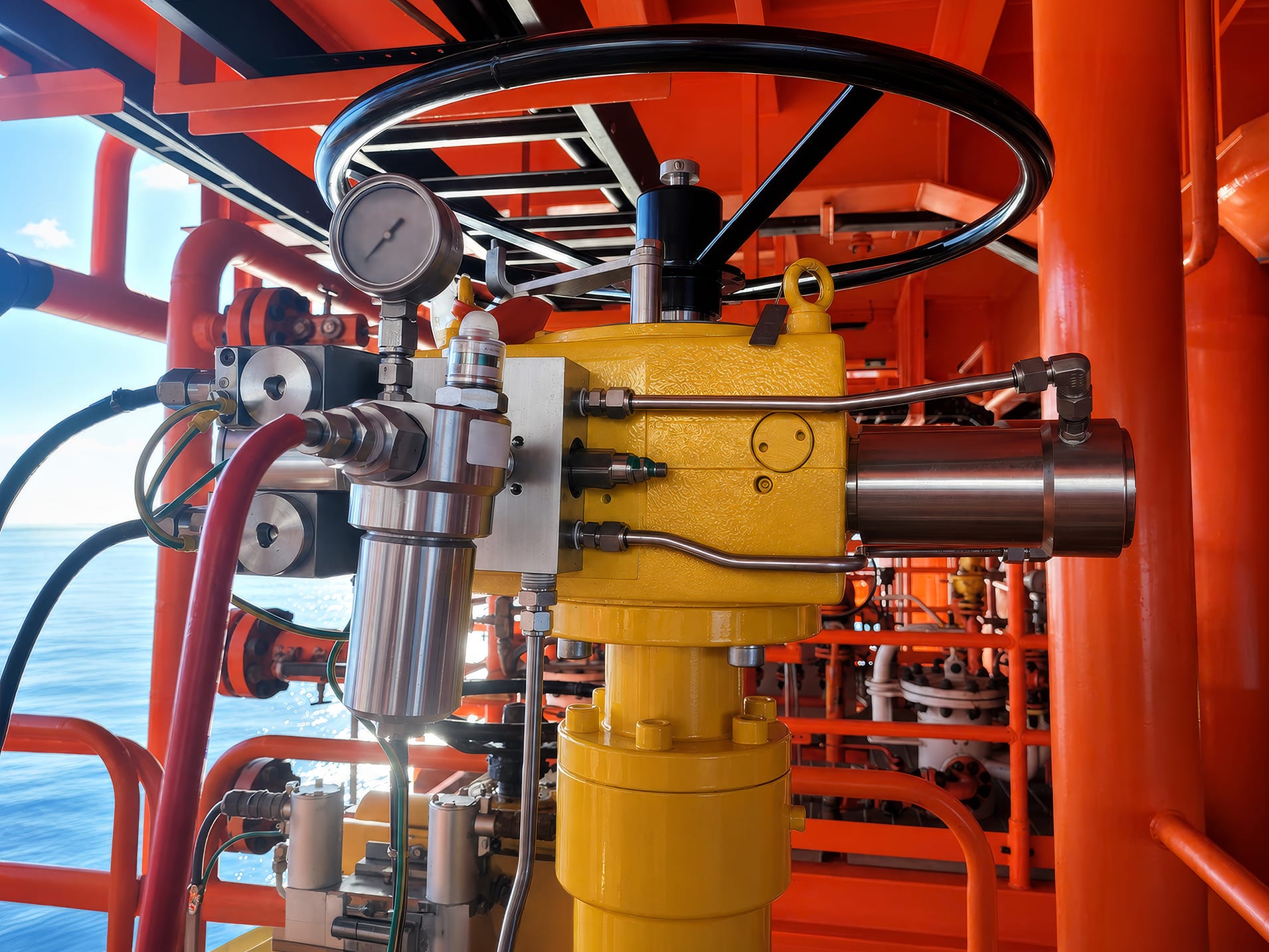
HYLINE electro-hydraulic actuators serve modulating, ESD and isolating duties on sliding stem, globe and control valves, with floating production among their listed applications. Thrust runs from 100 kgf to 100,000 kgf, with strokes up to 300 mm. HYLINE runs from a ring main at up to 300 bar or self-contained with an integrated HYFLOW unit, with spring-return or accumulator fail-safe. Cylinders are carbon steel with an offshore coating as standard, with a 316 stainless steel option.
HYFLOW for self-contained hydraulic power
HYFLOW smart hydraulic pumping units mount with the actuator, run on 24 V DC, draw below 1 W while holding position and deliver 70 to 207 bar from a 316L stainless steel housing. Fitted to HYLINE or HYLINE-R, it means a remote valve needs only a 24 V DC supply.
Quarter-turn valves, feedback and control
For quarter-turn ball, plug and butterfly valves, HYLINE-R Scotch yoke actuators are offered for offshore and marine service. HYTRACK position transmitters give 4-20 mA and HART 7 feedback, and the HYCONTROL positioner adds closed-loop control, diagnostics and HPU control, and can drive HYSTEP in its stepping mode. Each instrument’s certificates are listed on its product page.
Frequently asked questions
What are the safest methods for isolating sea valves on an FPSO without divers?
UK HSE guidance says that to inspect a sea valve it must be isolated from the sea by a blank over the hull opening, which can be placed by a remotely operated vehicle (ROV) rather than a diver. It also says sea valves should have remote means of operation and advises against splitting the downstream flange to test a valve. Agree the method for each vessel with the duty holder and class society.
Which valves on an FPSO need actuators?
Typically the topsides choke, control, emergency shutdown and blowdown valves, plus marine and utility valves in the hull such as ballast, cargo, sea water and firewater valves, and, on turret-moored vessels, shutdown valves that can sit in the turret manifold. Which valves are automated, and how each one fails, comes from the vessel’s process and marine safety studies.
How does vessel motion affect FPSO valve actuators?
An FPSO moves in six degrees of freedom, and its trim changes as cargo is loaded and offloaded. Equipment further from the centre of gravity moves further, so actuator mountings, brackets and tubing see cyclic loads. Give your actuator supplier the design motions and accelerations at each valve location so the selection and supports can allow for them.
Should floating production unit hydraulic systems use a central HPU or self-contained actuators?
Both work. A central HPU with a ring main can suit valves grouped close together, or a vessel where a ring main already exists. Self-contained actuators, such as HYLINE with an integrated HYFLOW unit, need only 24 V DC and a control signal, cut long hydraulic runs and stop one HPU outage affecting every valve. The two can be mixed on one vessel.
What type of actuator suits FPSO choke valves?
Choke valves need precise, repeatable adjustment and should hold position if power is lost. HYSTEP stepping actuators move the valve in discrete steps from electrical pulses and hold position under high load when external power is cut. They run on pneumatic or hydraulic supplies and are widely used on choke valves, including on FPSO vessels.
Do FPSO valve actuators need class approval or hazardous-area certification?
It depends on the system and the vessel. Classification societies publish rules for floating production units; the hull and mooring are classed, while classification of topside production facilities can be optional, so confirm early which systems fall under class. Hazardous-area requirements follow the zone where the actuator sits. Tell us the zone, gas group and temperature class, and we will confirm the certification for your exact unit.
Talk to our engineers about FPSO valve actuators
Planning a new FPSO, a conversion or a valve upgrade on a vessel already on station? Send us the valve type and size, the torque or thrust, the available supply (ring main pressure, air or 24 V DC), the fail-safe requirement and the area classification. Email sales@advanced-actuators.com or call +44 (0)1535 655151.
You can also contact our head office, or start with the HYSTEP and HYLINE product pages.