A choke valve actuator moves the trim of a production, gas lift or injection choke to a set opening and holds it there, so operators can control flow rate and wellhead pressure from the control room instead of at the tree. Offshore, that means wells can be started up, tested and balanced remotely, including on unmanned installations.
The right actuator depends on the choke, the duty and the platform. Fine, repeatable positioning matters most, but so do corrosion, weight, utilities, the hazardous area and what the choke should do if power or signal is lost.
What does a choke valve do?
A wellhead choke is a fixed or adjustable restriction that controls flow from a well. Its opening sets production rate and surface pressure, and affects the reservoir’s productive life and the demands on facilities downstream. Chokes are commonly sized for critical flow, where downstream pressure is about 55% of upstream pressure or less. The rate then depends on upstream pressure and choke opening, not on swings downstream, so choke position becomes the main lever on the well.
Fixed (positive) chokes use a bean with a set bore that is changed only with the well shut in. Adjustable chokes can be changed while the well flows, using needle-and-seat, cage or sleeve trims, and these are the ones that get automated.
Why automate choke valves offshore?
An automated choke turns a manual adjustment at the tree into a setpoint from the control room. Typical reasons:
- Remote flow management: balance wells against each other and against separator, compression and export limits without visiting each tree.
- Well testing: step a well through a series of steady rates while it flows to the test separator.
- Gas lift and injection: set the lift gas rate to each well and the rate into injection wells. In continuous gas lift the injection gas rate controls production, and injecting more gas than a well needs adds cost and can even reduce output.
- Start-up: open a well in planned steps after a shut-in (bean-up) to help limit sand production and near-wellbore damage.
Choke actuator options: stepping, hydraulic, pneumatic and electric
Start from the choke maker’s thrust or torque data, stroke and number of turns; the duty and the platform’s utilities then narrow the field.
| Actuator type | How it moves the choke | Typically suits |
|---|---|---|
| Stepping (pneumatic or hydraulic) | Each control pulse moves the choke one fixed step; it holds position between steps | Fine, repeatable adjustment; remote, low-power sites |
| Electro-hydraulic (linear or rotary) | A cylinder fed from a ring main or local pump gives smooth, proportional movement | Continuous modulation, high thrust or torque, fast stroking, spring or accumulator fail-safe |
| Pneumatic (diaphragm or piston) | Instrument air or gas drives the actuator, often through a positioner | Platforms with a reliable, clean air supply and moderate force needs |
| Electric | A motor and gearbox drive the stem from an electrical supply alone | Sites with no air or hydraulic supply; check duty rating and loss-of-power behaviour |
Offshore constraints that shape the choice
Corrosion and marine exposure. Salt-laden air, spray and washdown attack coatings, fasteners and seals. ISO 12944 has a CX corrosivity category for offshore environments, so ask about the coating system and the stainless grades of tubing, fittings and enclosures, not just the body.
Space, weight and limited utilities. Wellhead decks are crowded and weight matters. Small unmanned platforms are built for low energy consumption, so air, hydraulic and electrical supplies may all be limited, and actuators that draw little power between moves, or need only one utility, ease the load. Floating production adds vessel motion; see our guide to valve actuation on FPSO vessels.
Hazardous areas. Wellheads handle produced hydrocarbons, so the areas around them are commonly classified as hazardous; the platform’s area classification sets the zone at each choke. Zone 1 is where an explosive gas atmosphere is likely in normal operation; Zone 2 is where it is unlikely and, if it occurs, short-lived. Equipment must suit the zone, gas group and temperature class; flameproof (explosion-proof, Ex d) enclosures are a common protection method for actuator electrics.
Unmanned operation and maintenance cost. Every unplanned visit to an unmanned platform means a helicopter or vessel trip that weather can delay. Favour proven designs with long cycle life, a local position indicator and remote diagnostics that flag problems early.
Precision and holding position on choke valves
Operators need small, repeatable moves without overshoot or hunting. Erosive flow and high differential pressure also load the trim, so the actuator must hold its setting rather than drift. A stepping actuator does this by moving in fixed increments and holding between steps; a modulating actuator uses a closed-loop positioner to reach any setpoint and correct drift. For more on the stepping approach, see precise choke valve control with stepping actuators.
Feedback and control system integration
Remote choke control is only as good as the position signal coming back. A 4-20 mA position transmitter is a common choice, often with HART, which carries digital diagnostics over the same loop. Limit switches confirm end positions, and a mechanical indicator gives a local check. Agree early how each choke will be commanded, whether by pulses, a 4-20 mA setpoint to a positioner or discrete open and close signals, and whether the control system or the actuator closes the position loop.
Fail-safe positions for choke valves
A choke is a throttling device that restricts and controls flow. Shutting in a well is normally the job of the tree’s actuated valves, such as the production wing valve and the surface safety valve, which close automatically on loss of power supply.
The choke’s own fail position is a separate decision. A fail-in-last-position actuator leaves the choke where it is on loss of power, air or signal, so a utility trip does not move it. Where a choke must close or open on a trip, the actuator needs stored energy, such as a spring or accumulator. Practice varies between operators and fields, so each choke’s fail position should come from the operator’s safety analysis. Our guide to fail-safe valve actuators explains the options.
Checklist for specifying an actuated choke valve offshore
- Choke type, size and pressure class, with thrust or torque and stroke or turns
- Resolution and full-stroke time
- Fail position: last position, closed or open
- Supply: air or gas pressure, hydraulic pressure, or 24 V DC and the power budget
- Zone, gas group and temperature class
- Ambient temperature range, coating system and materials
- Command and feedback signals: pulses, 4-20 mA, HART, limit switches
- Weight and space envelope, manual operation and maintenance access
- Visit frequency and spares for unmanned platforms
Choke valve actuators from a UK manufacturer
Advanced Actuators has designed, built and tested valve actuators in Silsden, West Yorkshire, since 1969. Our established, field-proven ranges already cover the vast majority of real-world applications, and where a duty is genuinely different we add bespoke engineering.
HYSTEP stepping actuators for choke valves
HYSTEP converts electrical pulses into discrete mechanical steps using two solenoids, and holds position under high load even when external power is cut. It runs on pneumatic (3 to 12 bar) or hydraulic (50 to 300 bar) supplies, and its low consumption suits remote sites. HYSTEP is widely used upstream, especially on choke valves on production wellheads, flowlines, re-injection, gas lift and FPSO vessels, and thousands of units are deployed worldwide.
- HYSTEP CORE: carbon steel cylinders, 225 Nm at 4 bar, 18 steps per revolution, stroke up to 5 in, thrust up to 4,500 kgf.
- HYSTEP ADVANCED: 316L cylinders, 50 to 500 Nm, 12, 18 or 36 steps per revolution, stroke up to 10 in, thrust up to 15,000 kgf.
A detent unit locks each step, and HYSTEP is chemically bonded to withstand 10,700 Nm, a safety factor of 21. Units are IP66 and IP68 test certified, suit ambient temperatures of -30 °C to +80 °C, and have a built-in mechanical indicator and HYTRACK position feedback.
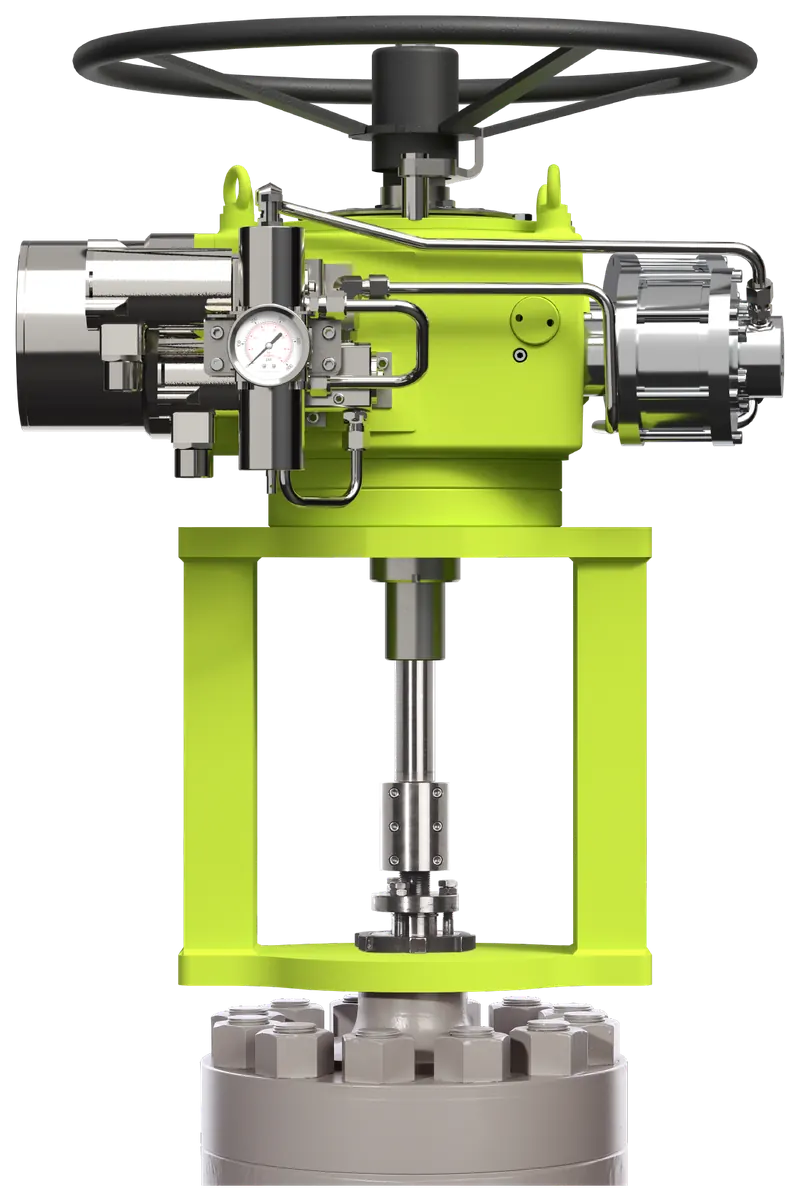
HYLINE with HYFLOW for self-contained electro-hydraulic duty
For linear valves that need continuous modulation, higher thrust or fast stroking, HYLINE electro-hydraulic linear actuators give 100 kgf to 100,000 kgf of thrust, strokes up to 300 mm and speeds of 2 mm/s to 200 mm/s, with spring-return or accumulator fail-safe builds. HYLINE runs from a hydraulic ring main at up to 300 bar, or self-contained with an integrated HYFLOW smart pumping unit, so no separate HPU is needed. HYFLOW runs from 24 V DC, draws below 1 W in steady state while holding position and has a 316L stainless steel housing rated IP66 and NEMA 4X. HYLINE cylinders are offshore coated as standard, with a 316 stainless steel option.
HYTRACK and HYCONTROL for feedback and positioning
HYTRACK is a two-wire, loop-powered 4-20 mA position transmitter with HART 7, a 12-bit contactless sensor and mechanical or proximity limit switch options, in a 316L housing rated IP66 and NEMA 4X. HYCONTROL adds closed-loop positioning for modulating duties on hydraulic and pneumatic actuators, with a 4-20 mA command, HART 7, a stepping mode and fault relay outputs. Tell us the zone, gas group and temperature class, and we will confirm the certification for your exact unit.
Frequently asked questions
What is a choke valve actuator?
A choke valve actuator is the powered device that moves a choke’s trim to a set opening and holds it there, in place of a handwheel. Operators can then adjust well flow and pressure from the control room. Common types are stepping, electro-hydraulic, pneumatic and electric, usually with a position transmitter to confirm the opening.
How do you automate a choke valve on an offshore platform?
Start with the choke maker’s thrust or torque, stroke or turns, and the fail position you need. Choose an actuator that suits the platform’s supply, hazardous area and required resolution, then add position feedback, commonly 4-20 mA with HART, so the control system can command and confirm each move. Plan mounting and maintenance access at the same time.
Is a stepping actuator or a modulating actuator better for a choke?
It depends on the duty. A stepping actuator moves the choke in fixed, repeatable increments and holds position between moves, which suits fine adjustment and remote, low-power sites. A modulating actuator with a positioner moves smoothly to any setpoint and can use a spring or accumulator to reach a set fail position. The fail position you need often decides it.
Can choke valves use electric actuators?
Yes. Electric choke valve actuators drive the trim through a motor and gearbox and need only electrical power, which helps where there is no instrument air or hydraulic supply. Check the duty rating for frequent small moves, the area classification and behaviour on loss of power. Self-contained electro-hydraulic actuators also need only electrical power.
Should a choke valve fail open, closed or in place?
There is no single answer. Some chokes are specified to stay in their last position on loss of power, air or signal, leaving shut-in to the actuated safety valves on the tree. Where a choke must close or open on a trip, its actuator needs stored energy, such as a spring or accumulator. Practice varies between operators and fields, so the operator’s safety analysis should decide.
How is a gas lift choke valve automated?
A gas lift choke on the injection line sets how much lift gas each well receives. With an actuator and position feedback, operators can adjust that rate remotely and rebalance lift gas between wells, without injecting more gas than each well needs. Steady, repeatable settings matter here, and HYSTEP stepping actuators are widely used on gas lift chokes.
Talk to our engineers about choke automation
Send us the choke type and size, thrust or torque, stroke, supply and area classification, and we will recommend an actuator and control package. Email sales@advanced-actuators.com, call +44 (0)1535 655151 or contact our head office. Or explore the HYSTEP stepping actuator range.