A stepping actuator moves a valve in fixed increments. Each control pulse produces one step, the actuator holds its position between pulses, and the valve position follows from the number of steps sent. The size of each step sets the resolution.
The term covers two quite different machines. Small electric stepper-motor actuators are used in refrigeration and air conditioning, while fluid-powered discrete stepping actuators use pneumatic or hydraulic pressure to step industrial valves, especially production choke valves. This guide explains both, then focuses on the industrial type.
What is a stepping actuator? Two meanings
The phrase “stepping actuator”, or “step actuator”, is used for two kinds of device, built for very different valves. The ISO 15926 reference data library for plant data defines it simply as an actuator that can be moved in discrete steps, with electrical and hydraulic subclasses.
Electric stepper-motor actuators
A stepper motor turns through a fixed angle for each pulse from its driver, so its position can be tracked by counting pulses. It develops full holding torque while its windings are energised. Small stepper-motor actuators are used in refrigeration and air conditioning, for example on electronic expansion valves that control refrigerant flow.
Hydraulic and pneumatic discrete stepping actuators
An industrial discrete stepping actuator also responds to electrical pulses, but its force comes from fluid pressure. Each pulse advances the output one fixed increment, and a mechanical lock holds it there against process loads without a continuous command. A pneumatic stepping actuator runs on a pneumatic supply and a hydraulic stepping actuator on hydraulic pressure. Our HYSTEP stepping actuators are widely used upstream in oil and gas, especially on choke valves.
How discrete stepping works
One pulse, one step
The control system sends a pulse and the actuator makes one step; ten pulses in the opening direction give ten steps open. Because every step is the same size, movement is repeatable and position follows from the steps sent since a known reference such as fully closed.
Resolution: steps per revolution and step angle
Resolution is set by the number of steps in one revolution of the output. The step angle is 360° divided by the steps per revolution:
- 12 steps per revolution: 30° per step
- 18 steps per revolution: 20° per step
- 36 steps per revolution: 10° per step
Where the output turns a threaded nut to drive a rising stem, stem travel per step is the thread lead divided by the steps per revolution. As an illustration, a choke needing 10 turns from closed to fully open would take 180 steps at 18 steps per revolution, or 360 at 36: finer adjustment, but twice the pulses for a full stroke.
Holding position between steps
Between pulses the actuator is locked, so the valve stays where it was put. A modulating actuator with a positioner, by contrast, keeps adjusting to hold the commanded position against friction and process forces.
How HYSTEP turns pulses into steps
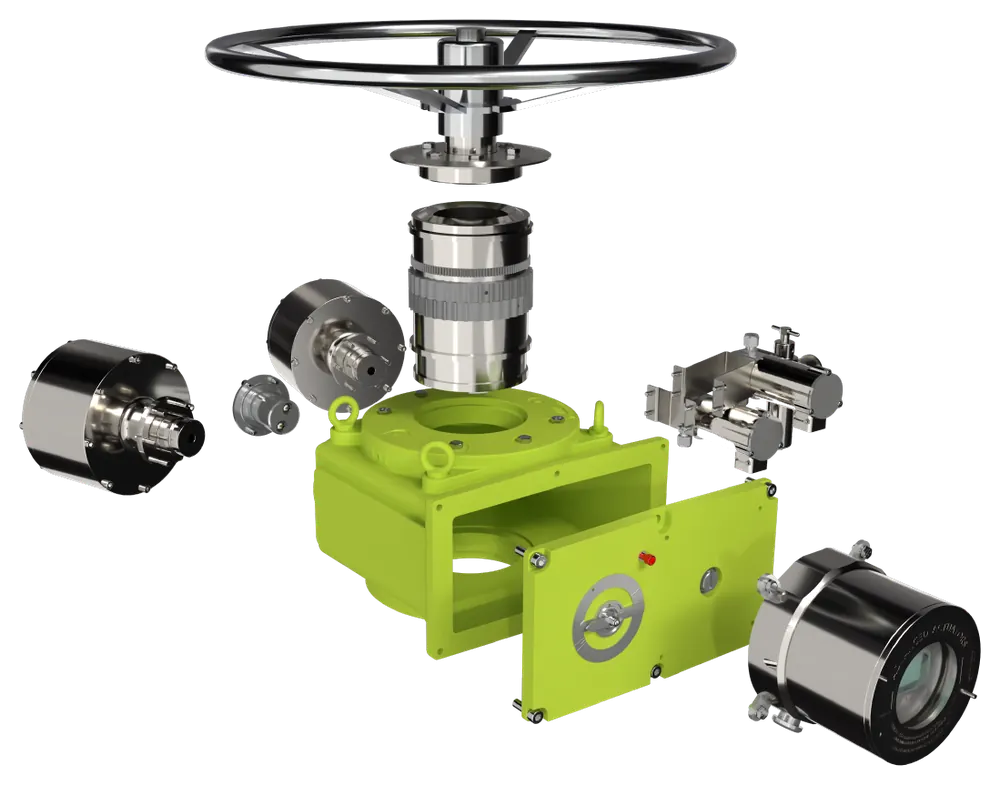
HYSTEP converts electrical pulses into discrete mechanical steps using two solenoids, and a detent unit locks each step. It holds position under high load even when external power is cut. It runs on pneumatic supply at 3 to 12 bar or hydraulic at 50 to 300 bar, with an integrated HYSOL pressure regulator. A built-in mechanical indicator still shows position if electronic feedback is damaged or disconnected.
Stepping vs modulating vs on-off actuation
The three differ in how they are commanded and what they do between commands.
| Stepping (discrete) | Modulating with a positioner | On-off | |
|---|---|---|---|
| Command | Pulses, one step each | Continuous signal, typically 4-20 mA | Open or close signal |
| Movement | Fixed increments | Continuous, to any point in the range | Full stroke, end to end |
| Between commands | Locked mechanically at each step | Positioner keeps correcting against friction and process forces | Rests at an end of travel |
| On loss of supply | Typically stays where it is (fail in place) | Depends on the build: spring, accumulator or stay put | Depends on the build: spring, accumulator or stay put |
| Typical duties | Choke valves, fine adjustments held for long periods | Control valves needing continuous modulation | Isolation and shutdown valves |
Advantages and limits of stepping actuators
Advantages
- Holds without power: the locked step holds the valve against load, even when external power is cut.
- No drift: a mechanically locked setting does not creep between commands.
- Low consumption: HYSTEP’s low consumption suits remote sites.
- Simple pulse control: open and close pulses from the discrete outputs of a PLC, RTU or DCS.
Limits to plan for
- Speed depends on step rate: full-stroke time is the steps needed divided by the step rate, so, at the same step rate, finer resolution means a slower full stroke.
- Resolution is fixed: the valve sits only at whole steps, so choose the steps per revolution at specification.
- A fail position needs stored energy: the actuator stays where it is on loss of supply. If the valve must move to a defined position instead, that energy has to be stored elsewhere in the system and the arrangement agreed at the design stage. Our guide to fail-safe valve actuators explains the options.
Control and feedback for stepping actuators
Counting steps or confirming with a position transmitter
At its simplest, the control system (a PLC, RTU or DCS) sends open or close pulses and keeps a running count. But a count is an assumption: if a step does not complete, or someone uses the manual override, the count and the real position disagree. A position transmitter measures the valve itself, so comparing the two shows any difference. HYTRACK is our position transmitter: 4-20 mA with HART 7 from a 12-bit contactless sensor, two-wire loop powered at 24 V DC, with mechanical or proximity limit switch options.
Driving a stepping actuator from a 4-20 mA signal
Where the control system works in 4-20 mA rather than pulses, a positioner with a stepping mode can do the stepping. HYCONTROL takes a 4-20 mA command, drives the actuator through suitable solenoid valves and checks the valve position until the two match. Its stepping mode has adjustable on and off times for fine, stepped positioning, and the A-HCR version has HYTRACK built in, so one unit gives control and feedback.
Where stepping actuators are used
Stepping suits valves adjusted in small increments and then held for long periods, often at remote sites. The clearest example is the adjustable choke, which controls flow from a well through an orifice and can be changed while the well is flowing. Choke size and condition influence production rate and also affect reservoir and surface facility life. HYSTEP is widely used upstream, especially on choke valves in:
- production wellheads
- flowlines
- re-injection
- gas lift
- FPSO vessels
Thousands of HYSTEP units are deployed worldwide. For more on choke duty, read automating choke valves on offshore platforms and precise choke valve control with stepping actuators.
How to choose a stepping actuator: selection checklist
- Valve and stem: rising stem or rotary, and the mounting interface.
- Force: thrust or torque from the valve maker’s data, with a suitable margin.
- Travel: stroke, or turns from closed to fully open.
- Resolution: the smallest change the process needs, which sets the steps per revolution.
- Speed: an acceptable full-stroke time for the steps needed.
- Supply: pneumatic or hydraulic, and the pressure available on site.
- Loss of supply: whether staying put is acceptable or a defined position is needed.
- Control and feedback: pulses or 4-20 mA through a positioner; step count, position transmitter or limit switches.
- Environment: ambient temperature, ingress protection, materials, paint, and the zone, gas group and temperature class.
HYSTEP CORE and ADVANCED stepping actuators
Our established, field-proven ranges already cover the vast majority of real-world applications, with bespoke engineering where a duty is genuinely different. For discrete stepping, that is HYSTEP, in two versions.
| HYSTEP CORE | HYSTEP ADVANCED | |
|---|---|---|
| Cylinders | Carbon steel | 316L stainless steel |
| Torque | 225 Nm at 4 bar | 50 to 500 Nm |
| Steps per revolution | 18 (20° per step) | 12, 18 or 36 (30°, 20° or 10°) |
| Stroke | Up to 5 in | Up to 10 in |
| Thrust | Up to 4,500 kgf | Up to 15,000 kgf |
| Nut box | Compact | Compact or external high-load |
| Manual operation | Carbon steel, top-mounted | 316L override, top or side-mounted |
| Paint and instruments | Our offshore paint standard | Standard or custom paint; instruments to our standard or customer specification |
| Best for | A cost-effective, ready-to-go choice for most projects | Projects needing bespoke performance or enhanced capabilities |
Both versions share:
- a cast spheroidal graphite iron body, with ISO 5211 mounting and custom options
- chemical bonding that withstands 10,700 Nm (a safety factor of 21), with six shear pins giving 120% maximum torque resistance
- mechanisms cycle tested to 1.75 million pecks
- tested to IP66 and IP68; ambient -30 °C to +80 °C
- 6-bolt cylinder integration, a transit screw for transport, commissioning and servicing, and 316L tubing and fittings
The latest generation has a stronger, lighter, more compact housing. For hazardous areas, tell us the zone, gas group and temperature class, and we will confirm the certification for your exact unit.
Frequently asked questions
What is a stepping actuator used for?
A stepping actuator is used where a valve needs small, repeatable changes of position that are then held. In oil and gas, our HYSTEP discrete stepping actuators are widely used on choke valves at production wellheads, flowlines, re-injection, gas lift and FPSO vessels. Small electric stepper-motor actuators are used in refrigeration and air conditioning.
Is a step actuator the same as a stepper motor?
Not quite. A stepper motor is an electric motor that turns through a fixed angle for each pulse; a step actuator, or stepping actuator, is the whole device that moves the valve. Some step actuators are built around a stepper motor. Industrial discrete stepping actuators instead use pneumatic or hydraulic pressure, switched by electrical pulses, and lock each step mechanically.
How does a hydraulic or pneumatic stepping actuator hold its position?
Between pulses the output is locked mechanically, so the valve stays where it was put without a continuous command. In HYSTEP, two solenoids convert the electrical pulses into discrete mechanical steps and a detent unit locks each one. HYSTEP holds position under high load even when external power is cut.
What happens to a stepping actuator if power or supply is lost?
A discrete stepping actuator is locked at its last step, so it stays where it is, often called fail in place. HYSTEP holds position under high load even when external power is cut. If the process needs the valve to go to a defined position on loss of power or supply instead, the energy to move it there has to be stored elsewhere in the system, and that arrangement should be agreed at the design stage.
How do you work out the step angle of a stepping actuator?
Divide 360° by the number of steps per revolution. At 12 steps each step is 30°, at 18 it is 20° and at 36 it is 10°. Where the output turns a nut on a rising stem, the stem travel per step is the thread lead divided by the steps per revolution.
Can a stepping actuator be controlled with a 4-20 mA signal?
Yes, through a positioner. The actuator itself responds to pulses, but a positioner such as HYCONTROL takes a 4-20 mA command, checks the valve position against it and, in its stepping mode, drives the actuator with adjustable on and off times. Position feedback can come from a HYTRACK transmitter, which gives 4-20 mA with HART 7.
Talk to our engineers about stepping actuators
Send us the valve type and size, the thrust or torque required, the stroke or number of turns, the resolution and stroke time you need, your pneumatic or hydraulic supply and the area classification, and our engineers will recommend a HYSTEP configuration for the duty. Email sales@advanced-actuators.com, call +44 (0)1535 655151 or use our contact page.