A central hydraulic power unit (HPU) uses one pump station to pressurise a ring main, which feeds many valve actuators through branch lines. A self-contained hydraulic actuator carries its own motor-driven pump at the valve, so each actuator needs only an electrical supply and a control signal. It is often called a self-contained electro-hydraulic actuator, though “electro-hydraulic” alone can also mean an actuator fed from a ring main.
Neither architecture is right everywhere. A ring main still suits plants with many actuators close together, or sites with an existing hydraulic system that has capacity to spare. A self-contained actuator is usually the better fit where valves are spread out, remote or unmanned, where new valves are being added, or where one fault at the HPU must not affect every valve it feeds.
What is a central hydraulic power unit for actuators?
A hydraulic power unit is a pump station. It typically combines an electric motor and pump, a fluid reservoir, filters, a relief valve that limits maximum pressure and, often, accumulators that store pressurised fluid. One HPU can serve many actuators across a plant, platform, terminal or pumping station.
How a ring main feeds valve actuators. On many sites the pressure and return lines run as a closed loop, or ring main, with branch lines to each actuator, where a solenoid valve or control manifold directs fluid to open or close the valve. Isolating valves let a damaged section be shut off while the rest of the ring stays in service, and larger HPUs commonly have duty and standby motor-pump sets.
What is a self-contained electro-hydraulic actuator?
A self-contained electro-hydraulic actuator puts a small motor-driven pump, reservoir and control manifold on the actuator itself, so the pressurised fluid stays at the valve. Electrically it behaves like any other field device: it needs power and a command signal, typically 4-20 mA for modulating duty, and usually returns position feedback.
What makes it a smart hydraulic actuator? “Smart” usually means the actuator closes its own control loop and talks to the control system. A local controller moves the actuator until measured position matches the command. HART runs over the same 4-20 mA wiring and carries diagnostic data, which can help teams spot developing problems before a valve fails to move.
Electro-hydraulic actuator vs HPU: the main trade-offs
Shared downtime risk and redundancy
A central HPU shares its downtime risk with every valve it feeds: a pump fault, a control failure, contaminated fluid or a damaged main can affect many actuators at once. Standby pumps and ring isolation valves reduce the risk, but add equipment to maintain. With a self-contained actuator, a fault normally affects one valve while the rest of the site keeps running. The trade-off is more motors, pumps and electronics spread across the site, each needing its own checks.
Pipework length, leak paths and safety
Every fitting on high-pressure tubing is a potential leak path. Leaks waste fluid, let dirt in and can pollute ground or water. The UK Health and Safety Executive (HSE) also warns that even pinprick punctures in hydraulic pipework can inject fluid under the skin and cause major injury. A self-contained actuator keeps its fluid in a short local circuit, so long tubing runs and their joints largely disappear.
Fluid cleanliness and maintenance
Particle contamination is widely regarded as a leading cause of wear and failure in hydraulic systems, and fluid cleanliness is commonly specified as an ISO 4406 code. New ring main pipework needs flushing before commissioning, and dirt entering at one point can reach every actuator downstream. On the other hand, a central HPU concentrates filters, fluid sampling and pump servicing at one skid.
Electrical supply and cabling
A ring main needs a large electrical supply at the HPU and little at each valve. A self-contained actuator moves that demand to the valve, so each unit needs power cable sized for the current its motor draws while moving. At 24 V DC, currents are high for a given power, so check voltage drop on long runs. In the UK, for example, the wiring regulations (BS 7671) require it to be limited so equipment works properly.
Heat, duty cycle and stroke speed
Hydraulic losses become heat, and sustained fluid temperatures above about 82 °C damage most seal compounds. A unit that runs its motor only while the valve moves produces little heat at rest. In a university study on a test crane, a self-contained electro-hydraulic cylinder used about 62% less energy over a working cycle than a valve-controlled one on a constant-pressure supply; savings on valve duty will differ. For continuous modulating duty, check the local motor’s duty rating. Stroke time depends on cylinder volume and available flow, so fast closure of a large valve usually relies on a spring or accumulator rather than the pump alone.
Fail-safe options in each case
Both architectures use the same two main methods: a spring that drives the valve to its safe position on loss of power, signal or supply pressure, or a charged accumulator that delivers a final stroke. On a ring main, springs and local accumulators still protect the valve if the line from the HPU is lost; a central accumulator cannot help once that line has failed. Gas-charged accumulators need periodic pre-charge checks, and their stored energy must be released or isolated before maintenance. Our guide to fail-safe valve actuators and fail-safe modes explains the options, and our article on fail-safe hydraulic actuators for ESD valves covers shutdown duties.
Remote and unmanned sites
For a few isolated valves at a remote wellhead, pipeline block valve station or unmanned platform, a dedicated HPU and the maintenance visits it needs can be hard to justify. An actuator that needs only a DC supply, draws very little power while holding position and reports its health over HART is often a better fit. The same questions apply on floating production vessels, where space is tight and the hull is always moving.
Retrofit and expansion
Adding a valve to a ring main means new branch lines, fittings and flushing, plus a check that the HPU has spare capacity. A self-contained actuator needs a mounting, power and cabling, and leaves the existing hydraulic system untouched.
When a hydraulic ring main still makes sense
A central HPU remains a sound choice when:
- Many actuators are grouped closely, such as in a manifold area, tank farm or turbine hall.
- An HPU and ring main already exist, with spare capacity and established maintenance routines.
- Many valves need frequent, fast strokes that a large central accumulator bank can supply.
- Running tubing to each valve is easier than running power cable.
The two can also be mixed: a ring main for a dense cluster and self-contained units for outlying, new or critical valves.
Decision table: self-contained actuator or central HPU?
| Factor | Central HPU and ring main | Self-contained electro-hydraulic actuator |
|---|---|---|
| Valve layout | Many valves close together | Valves spread out, remote or isolated |
| Downtime risk | Shared by every valve fed | Limited to one valve |
| Pipework | Mains, branches and many joints | Short local circuit on the actuator |
| Electrical supply | Large supply at the HPU | Power and signal cable to every valve |
| Maintenance | Concentrated at one skid, plus the mains and branches | Spread across individual units at each valve |
| Expansion | Needs spare capacity and new branches | Add a unit, power and cabling |
| Best fit | Existing hydraulics, dense clusters | Remote, unmanned, retrofit and new valves |
Checklist: choosing how to power hydraulic valve actuators
- How many valves are there, and how far apart?
- Does an existing HPU have spare flow, pressure and accumulator capacity?
- What fail-safe position does each valve need, and must it work if the ring main is lost?
- What stroke time is required, especially on ESD valves?
- Is the duty on-off, occasional or continuous modulating?
- What power is available at each valve, and over what cable length?
- What is the zone, gas group and temperature class?
- How often can people reach the site, and what expansion is planned?
How HYLINE, HYLINE-R and HYFLOW fit both approaches
Our established, field-proven ranges cover both architectures, so the site decides the power source, not the actuator. Where a duty is genuinely different, we add bespoke engineering.
HYLINE electro-hydraulic linear actuator
HYLINE electro-hydraulic linear actuators combine electric control with hydraulic force for modulating, ESD and isolating duties on sliding stem, globe and control valves. HYLINE runs from a hydraulic ring main at up to 300 bar, or as a self-contained package with an integrated HYFLOW 24 V DC pumping unit and no separate HPU. Thrust runs from 100 kgf to 100,000 kgf, with spring-return or accumulator fail-safe builds.
HYLINE-R Scotch yoke for quarter-turn valves
The HYLINE-R Scotch yoke actuator suits ball, plug and butterfly valves. It runs on hydraulic or pneumatic supply, double-acting or spring-return, with an optional integrated HYFLOW for a self-contained hydraulic package.
HYFLOW smart hydraulic pumping unit
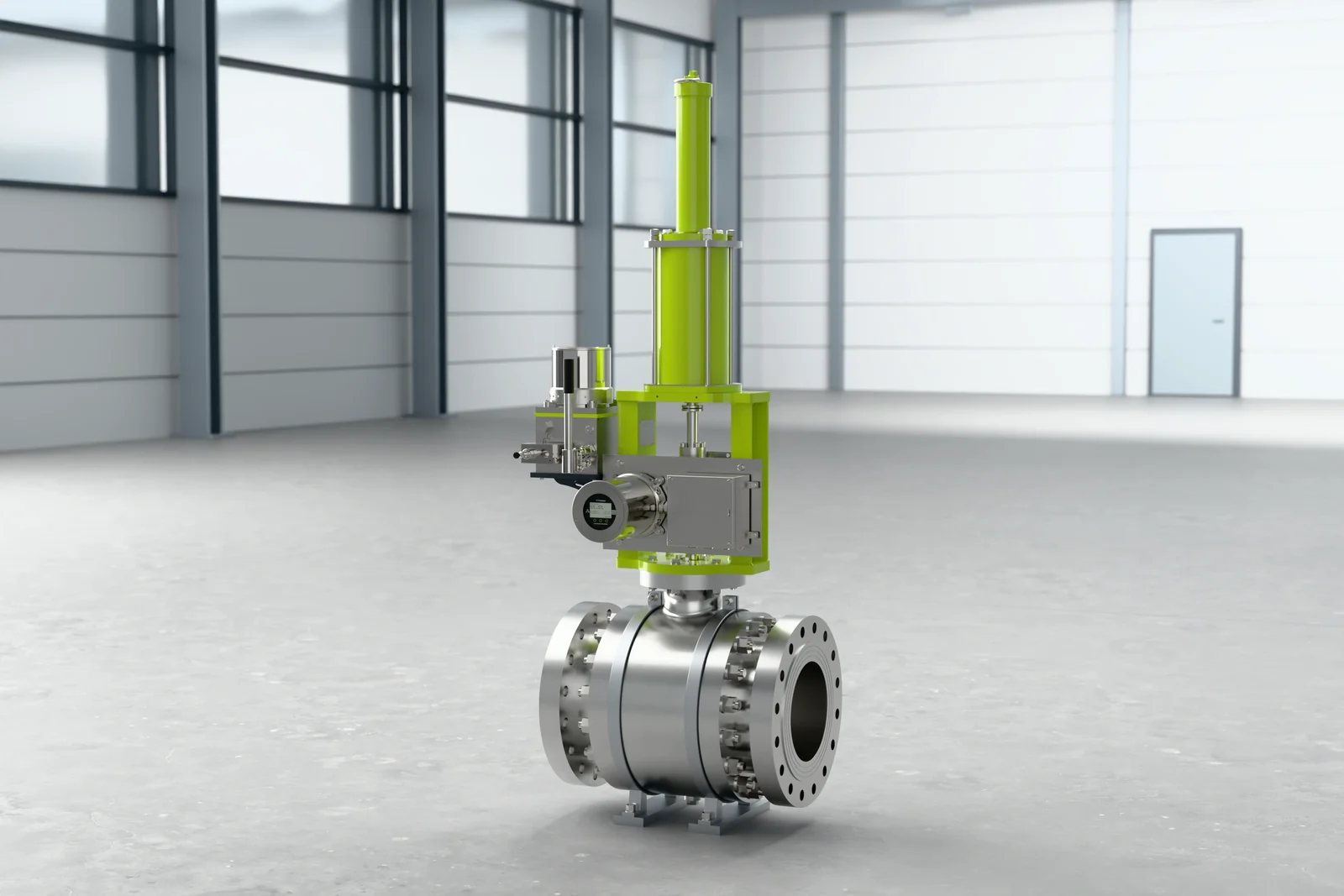
The HYFLOW smart hydraulic pumping unit mounts with the actuator and gives each valve its own local power source, with less pipework and redundancy at the device.
- 24 V DC smart brushless motor, 90 W to 600 W
- Below 1 W in steady state while holding position
- Flow 0.4 to 3 l/min; pressure 70 bar (1,000 psi) to 207 bar (3,000 psi)
- Closed-loop flow and pressure control; 4-20 mA and HART 7
- 316L stainless steel housing; IP66 and NEMA 4X
Read more about HYFLOW smart hydraulic pumping units for actuator systems. For hazardous areas, tell us the zone, gas group and temperature class, and we will confirm the certification for your exact unit.
Frequently asked questions
What is a self-contained hydraulic actuator?
A self-contained hydraulic actuator carries its own motor-driven pump, reservoir and control manifold at the valve. It needs only an electrical supply and a control signal, with no hydraulic lines back to a central power unit. That suits remote valves, retrofits and sites without hydraulic infrastructure.
What is a smart hydraulic actuator?
A smart hydraulic actuator is an electro-hydraulic actuator with on-board control and digital communication. It compares the command signal with its own position feedback, moves the actuator to correct any difference, and reports status and diagnostics, often using HART over the existing 4-20 mA wiring, which makes remote monitoring easier.
Is an electro-hydraulic actuator better than an HPU?
Neither is better everywhere. A self-contained electro-hydraulic actuator avoids shared downtime risk, long pipe runs and ring main flushing, and suits valves that are spread out, remote or newly added. A central HPU still makes sense for many actuators close together, or where a ring main with spare capacity exists. The two can be mixed on one site, valve by valve.
How do you size a hydraulic power unit for actuators?
Start with the fluid volume each actuator needs per stroke, how many may move at once and the stroke times required. Pump flow, accumulator volume and reservoir size follow, with margin for leakage and future valves, and pressure losses along the ring main must be checked. A self-contained unit is sized per valve, against its thrust or torque and speed.
Can a self-contained hydraulic actuator be fail-safe?
Yes. The usual methods are a spring that drives the valve to its safe position when power or signal is lost, or a charged accumulator that provides a final stroke. HYLINE is available with spring-return or accumulator fail-safe builds, and HYFLOW works with fail-safe actuators or can be configured with a fail-safe function. Confirm the fail position for every valve.
Does a self-contained hydraulic actuator use a lot of power?
It depends on motor size and duty. Most energy is used while the valve moves. HYFLOW, for example, uses a 24 V DC motor of 90 W to 600 W, draws 2 A to 20 A while moving and below 1 W in steady state while holding position. That suits a limited supply, provided the cabling can carry the current while moving.
Talk to our engineers about powering your valve actuators
Not sure which approach suits your valves? Send us the valve type and size, torque or thrust, stroke time and fail-safe position, available power supply and area classification.
Email sales@advanced-actuators.com, call +44 (0)1535 655151 or contact our head office. Full specifications are on the HYFLOW product page.